


You sat in the laser-vision chair and heard the words “not a LASIK candidate.” It can feel like a perfect sight just left the room, but it hasn’t. In sun-splashed Southwest Florida, clear vision powers tee shots at Tiburón and dolphin-spotting off Sanibel. At Snead Eye Group—led by Dr. Brad Snead—we help patients in Fort Myers, Naples, Cape Coral, and Bonita Springs stay sharp. When LASIK is off the table, the implantable Collamer lens (ICL) often steps in.
We’ll cover:
- why LASIK sometimes says “no”,
- how the paper-thin ICL corrects vision inside the eye,
- which route—LASIK, ICL, or Plan C—best fits your goals.
We keep jargon light and facts solid.
Why Some Eyes Fail The Lasik Screen
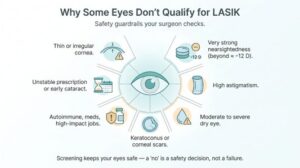
Every LASIK consult begins with a series of measurements that check corneal thickness and shape, prescription stability, and overall eye health. These numbers protect you. If any fall outside safe limits, a responsible surgeon pauses.
Thin or irregular corneas raise the first warning. Because LASIK removes tissue, enough must remain to keep the cornea stable. If the cornea already sits at its structural minimum, removing more would be unsafe.
Prescription strength comes next. In the United States, LASIK reliably corrects up to about −12 diopters of myopia. Eyes beyond that range need too much tissue removed for a predictable result. Surgeons also watch for high astigmatism, since extreme cylinder power can leave vision hazy even after treatment.
Dry eye matters too. Creating a LASIK flap severs tiny nerves that stimulate tears. When eyes are already parched, postoperative dryness can linger and blur vision. Doctors guide chronic dry-eye patients toward procedures that leave those nerves intact.
Some eyes show early keratoconus or carry scars from injury or infection. In such cases, laser reshaping can push a fragile cornea into permanent distortion. Systemic factors (autoimmune disease, certain medications, or jobs with frequent eye impact) can also turn the answer to “no LASIK” for safety.
Age rounds out the list. Surgeons want a stable prescription for at least a year, which usually occurs by the mid-twenties. At the upper end, early lens changes or hints of cataract steer patients toward lens-based options.
These guardrails follow FDA and professional-society guidelines designed to keep vision seekers safe.
Translation: a LASIK rejection doesn’t mean your eyes failed; it means the screening worked. Now we pivot to a solution built for these edge cases.
Meet The Implantable Collamer Lens (ICL)
Imagine a contact lens so thin and flexible a surgeon can fold it like a taco, slip it through a pin-size opening, and let it unfold behind your iris. There it stays out of sight, quietly bending light so it reaches your retina in sharp focus. That device is the implantable Collamer lens.
ICL leaves your cornea untouched. According to Snead Eye, a Southwest Florida ophthalmology practice, preserving the corneal nerves also means the procedure doesn’t aggravate dry eye, a relief for contact-lens wearers who already battle irritation. No laser reshaping, no surface flap, no added dryness. The lens rests in the natural space between your colored iris and the eye’s clear lens, where it remains invisible and comfortable.
The material, called Collamer, blends collagen with a medical-grade polymer that eye tissue accepts without irritation. Surgeons have used earlier versions for more than two decades. The current EVO model includes a tiny central port that lets fluid flow, which streamlines surgery and protects eye pressure.
Who qualifies? Adults between twenty-one and forty-five whose main problem is moderate to extreme nearsightedness, up to about minus twenty diopters, with as much as four diopters of astigmatism. Eyes need adequate internal depth and healthy corneal cell counts, but thin or irregular corneas rarely block the door.
Surgery happens in an outpatient suite. Numbing drops go in, a three-millimeter incision opens, the folded lens glides through, and the wound seals on its own. Total chair time is about thirty minutes per eye. Most people notice sharper sight the next morning and reach stable clarity within a week.
Because no tissue is removed, the lens is reversible. If technology leaps forward or a future cataract needs attention, a surgeon can exchange or remove the ICL and move ahead.
In short, ICL turns many “no-LASIK” verdicts into crisp, glasses-free vision, with a safety net built in.
ICL vs LASIK: key differences
 Surgical method and invasiveness
LASIK reshapes the cornea from the outside. The surgeon lifts a paper-thin flap, sculpts the exposed tissue with a cool laser, then smooths the flap back into place. Total laser time is often under a minute per eye. Because corneal nerves are sliced, you feel nothing during the pass and only mild scratchiness afterward.
ICL works inside the eye. Instead of removing tissue, the surgeon slips a flexible lens through a three-millimeter incision at the cornea’s edge. The lens unfolds behind the iris and starts focusing light right away. No corneal flap, no tissue removal, and surface nerves stay intact.
Think of LASIK as precise carpentry on the cornea, while ICL is a lens upgrade that adds power rather than subtracting tissue. LASIK stays on the outer wall, so infection risk is low, but the flap is permanent. ICL enters the eye under sterile conditions yet leaves the cornea structurally whole and free of long-term flap worries.
Candidacy and prescription range
Lasers have limits. LASIK comfortably corrects up to about minus twelve diopters of myopia. Beyond that, it would need to remove too much tissue. The cornea must also be thick enough to tolerate both the flap and the sculpting beneath it. If it is wafer-thin or slightly cone-shaped, LASIK steps aside.
ICL was designed for the outliers. It corrects nearsightedness from roughly minus three to minus twenty diopters, with up to four diopters of astigmatism in the same lens. Because tissue is not removed, corneal thinness rarely blocks the door. Surgeons instead measure chamber depth and the health of the inner corneal cell layer. If there is enough room and those cells look robust, the green light appears even for eyes LASIK labeled extreme.
Age matters, but differently. LASIK is cleared once vision stabilizes—usually the mid-twenties—and stays an option well into the forties if the cornea looks healthy. ICL fits the window of twenty-one to forty-five, before natural lens changes hint at cataracts. Many patients rejected for LASIK on corneal grounds fall squarely into the ICL range.
Bottom line: LASIK serves the middle of the prescription bell curve on healthy, thicker corneas. ICL steps up when prescriptions soar, corneas thin, or both.
Recovery and day-to-day comfort
LASIK is the sprinter of eye surgery. Many people read the clock on the wall the same evening and drive the next day. The flap seals quickly while medicated drops control inflammation. Most dryness or light sensitivity fades within a week, and by one month the eyes usually feel normal.
ICL is more of a middle-distance run. Vision sharpens overnight but can look milky for a few days while the eye adjusts. Surgeons schedule a next-morning pressure check, then clear patients for desk work within forty-eight hours. Because no flap exists, rubbing or sports collisions pose less worry. You will use antibiotic and anti-inflammatory drops for at least a week and return for extra checks to confirm safe pressure.
Neither recovery is painful. At worst, patients report a scratchy feeling after LASIK or a dull ache inside the eye for twenty-four hours after ICL. Both resolve with over-the-counter pain relievers and rest. LASIK wins the instant-gratification race, but ICL avoids weeks of artificial tears often needed to tame LASIK-related dryness.
Visual quality and night vision
Both surgeries aim for 20/20 or better, but the experience can differ.
LASIK delivers high-definition clarity for most moderate prescriptions. Because it reshapes the cornea, some patients notice glare or starbursts in low light, especially if pupils dilate wider than the treatment zone. Modern wavefront lasers trim that risk, yet it remains a known side effect.
ICL uses a manufactured optic, so it often produces razor-sharp detail even in eyes once labeled legally blind without glasses. The trade-off? The lens edge can scatter light and create halos around headlights or streetlamps. According to a 2023 peer-reviewed study, halos were reported more often after ICL than after LASIK or SMILE, though overall visual-quality scores stayed similar for all three procedures.
Most patients adapt within months as the brain edits out the extra rings. Surgeons can tweak lens sizing or position if halos persist. People with extreme prescriptions often find daytime sharpness outweighs a faint nighttime glow.
Takeaway: LASIK can spark surface-based glare; ICL may introduce halo rings early on. Choose the artifact you would rather manage.
Safety profiles and risks
No surgery is risk-free, but the hazard zones differ.
With LASIK, the headline concern is dry eye. Cutting a flap severs nerves that drive tear production, so eyes can feel gritty for weeks and occasionally months. Most heal uneventfully, yet a small fraction struggle with chronic dryness.
Night-vision side effects land next on the LASIK list. If a treated zone is smaller than a fully dilated pupil, extra light scatters and creates glare. Enlarged optical zones reduce that risk but cannot erase it.
ICL shifts attention inside the eye. Because a foreign lens shares space with your natural one, surgeons monitor for lens-induced cataract over time. The latest EVO design has cut that risk to a sliver, but check-ups remain essential. Surgeons also watch intraocular pressure; if the lens sits too snugly, it can slow fluid flow and nudge pressure upward. Early detection manages the issue with drops or a quick adjustment.
Infection risk differs too. LASIK works on the surface, where a closed flap keeps infection rare. ICL enters the eye, so the stakes are higher, yet careful prep keeps endophthalmitis rates far below one percent in large studies.
Neither procedure wins a blanket “safer” label. The answer depends on your anatomy and comfort with each risk profile.
Cost and insurance realities
Sticker shock can arrive quickly in refractive surgery.
LASIK typically lands near two thousand dollars per eye. Pricing varies by region, but most reputable practices cluster in that zone. The fee covers pre-op scans, the laser session, and a year of follow-up.
ICL costs more, closer to four thousand dollars per eye. The precision-made implant accounts for much of the gap.
Insurance rarely covers either procedure because both are elective. Flexible Spending or Health Savings Accounts can ease the cost, and many clinics stretch payments over two to five years with zero-interest plans. On a monthly basis, the difference often equals a streaming bundle.
Long-term value matters too. Contacts, solutions, and updated frames add up, especially for high prescriptions. Patients who run the math often find the higher ICL fee pays off within ten years while delivering glasses-free vision from day one.
Focus on total lifetime vision costs, not just the first swipe of a card.
EVO ICL: The Modern Upgrade
Lens design keeps moving. In March 2022, the FDA cleared the EVO ICL, an updated model with two key changes: a tiny central port that lets fluid circulate, which removes the need for a pre-surgery laser opening in the iris, and built-in toric power that corrects up to four diopters of astigmatism.
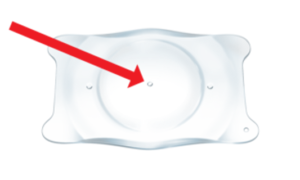
Results have been strong. According to global post-market surveys, millions of EVO lenses now sit comfortably inside eyes worldwide, and patient-satisfaction scores top ninety-nine percent. Surgeons like the streamlined workflow, and patients appreciate skipping an extra laser step while still gaining crisp, stable vision.
If you qualify for ICL today, the EVO model is likely the one on offer, delivering fewer steps, equal safety, and the widest prescription range so far.
Beyond LASIK and ICL: Backup Plans Worth Knowing
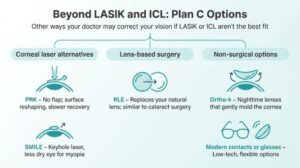
ICL solves most “no-LASIK” cases, yet some eyes need a different tactic. Knowing the full playbook helps you ask sharper questions in the exam room.
Photorefractive keratectomy, or PRK, uses the same laser as LASIK but skips the corneal flap. Surgeons remove the surface skin, reshape the tissue underneath, and let the skin regrow. Recovery stings and vision clears slowly, but the flap-free approach attracts athletes and pilots who worry about impact.
SMILE (small incision lenticule extraction) carves a lens-shaped sliver inside the cornea with a femtosecond laser, then removes it through a keyhole cut. No flap, less dry eye, and vision sharpens within days. The limitation: it treats only myopia and moderate astigmatism, and not every clinic owns the laser.
Refractive lens exchange mimics cataract surgery. The surgeon removes the natural lens and swaps in an artificial one matched to your prescription, sometimes with multifocal zones for reading. Basic cataract surgery is often covered by insurance, but RLE and premium IOLs are patient-paid. RLE suits people over fifty whose lenses are beginning to cloud or who want to skip future cataracts.
Some people choose zero surgery. Orthokeratology molds the cornea overnight with rigid contacts, giving daytime clarity that resets each morning. Others stay with modern soft lenses or lightweight frames until technology moves forward.
These alternatives show there is always a plan C waiting if plans A and B fall short.
Next Steps: Your Decision Road Map
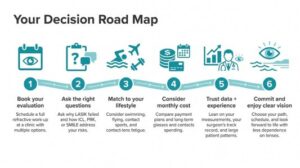
First, schedule a full refractive work-up with a practice such as Snead Eye Group that offers both corneal and lens-based procedures. A single-procedure clinic may lean toward its only option, while a balanced menu keeps the focus on what your eyes need.
Arrive with questions. Ask the doctor why LASIK failed your screening and how ICL, PRK, or SMILE avoid that issue. Request the numbers: corneal thickness, chamber depth, cell counts. Hard data grounds the conversation and makes a second opinion easier.
Factor in lifestyle. Marathon swimming in the Gulf favors a flap-free eye. Flying corporate jets may make one-day LASIK recovery more attractive than a week of ICL settling time. Weight training, boxing, or contact-lens fatigue can also steer the choice once you say the activities aloud.
Discuss cost in monthly terms, not lump sums. Many people find an eight-year glasses budget already covers an ICL payment plan. Decide whether to invest now or keep paying later.
Finally, trust patterns over internet anecdotes. Tens of millions have sailed through LASIK, and millions enjoy EVO ICL. When your test results, your surgeon’s experience, and your priorities all point the same way, that harmony is your green light.
Commit, schedule, and look forward to the moment you lift your head from the slit lamp and see the world without corrective lenses.
The snapshot: LASIK vs ICL at a glance
If you prefer the scoreboard first, here is the match in one quick look. Check the grid, spot your priorities, and refer back to the deeper explanations above.
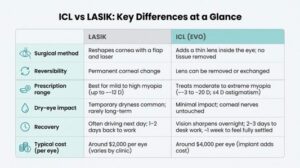
| Key factor | LASIK | ICL (EVO) |
| Prescription range | Up to ≈ −12 D myopia; moderate hyperopia or astigmatism | −3 D to −20 D myopia; ≤ 4 D astigmatism |
| Dry-eye impact | Temporary dryness common; rarely long-term | Minimal, nerves untouched |
| Reversibility | Permanent tissue change | Lens removable or exchangeable |
| Typical cost (per eye) | ≈ $2,000 | ≈ $4,000 |
| Back-to-work speed | 1–2 days | 2–3 days (clear vision in 1 week) |
Keep this cheat sheet handy when you meet your surgeon; it keeps everyone focused on the benefits that matter most to you.