Northwell’s Phelps Hospital has performed the first robotic Whipple procedure in Westchester County. This highly complex operation, a crucial treatment for pancreatic, duodenal, and bile duct cancers, offers patients the highest level of precision and efficiency, while shortening hospital stays and recovery times.
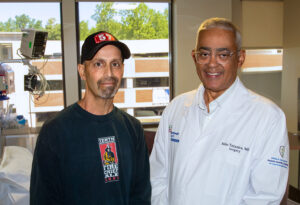
David Liburdi, 63, received the pioneering surgery after being diagnosed with a precancerous lesion that progressed to Stage 1A pancreatic cancer. His remarkably swift recovery allowed him to return home four days post-surgery—significantly shorter than the typical hospital stay of 12 days for this operation.
“The Whipple procedure is one of the most demanding and intricate operations in cancer surgery, requiring immense precision due to the complex anatomy and major blood vessels involved,” said Julio Teixeira, MD, director of minimally invasive surgery and robotics at Phelps Hospital. “Performing this with the Da Vinci robotic system allows us to utilize advanced features like enhanced visualization and superior dexterity, leading to a more complete cancer resection and, as David’s case demonstrates, can significantly improve patient recovery times. This milestone positions Phelps at the forefront of advanced surgical care in Westchester.”

The Whipple procedure involves the removal of the head of the pancreas, the duodenum (first part of the small intestine), the gallbladder, and the bile duct, followed by reconstruction of the remaining digestive organs. Robot-assisted surgery enhances a surgeon’s ability to perform these delicate maneuvers with greater accuracy and control. Instead of one large incision, surgeons operate through a few tiny incisions, allowing for faster recovery with less pain, scarring and blood loss than open surgery.
Mr. Liburdi’s journey began with severe, unexpected stomach pain in early 2026, leading to an emergency visit to Northwell’s Northern Westchester Hospital. Initially suspected to be gallstones, an endoscopy revealed the precancerous growth, leading to the life-saving Whipple procedure at Phelps.
“To be home in just four days after such a major surgery was truly incredible,” Liburdi said. “Dr. Teixeira and the entire team at Phelps were phenomenal, providing not just expert care but also a personal touch that made all the difference. Knowing this advanced surgery was available close to home, and avoiding trips into the city for such a demanding time, made it so much easier every inch of the way.”
Phelps continues to enhance its robotic surgery capabilities with the addition of the latest Da Vinci 5 system. These state-of-the-art robots feature a more sophisticated computer interface, enabling advanced applications such as overlaying patient CT and MRI scans directly onto the surgical field for enhanced precision. The new systems also offer advanced data analytics and forensics on surgical technique, providing surgeons with insights to further refine their skills and improve patient outcomes.
“At Phelps, we are commited to bringing the most advanced surgical capabilities to our communities,” said Gary Giangola, MD, vice president of surgical services for Northwell’s Western Region and surgeon-in-chief for its Northern Region. “The next-generation capabilities integrated into these robotic systems are fundamentally reshaping surgical practice, empowering our surgeons to achieve unparalleled precision, efficiency and outcomes. This enables us to deliver world-class care right here in Westchester, and to lead the evolution of surgical excellence throughout the region.