


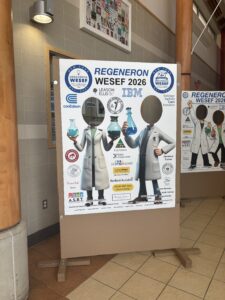
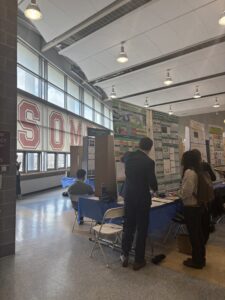
 On a recent Saturday morning, the halls of Somers High School were filled with a steady hum of voices, footsteps, and quiet focus. More than 800 high school students from over 40 schools across Westchester and Putnam counties gathered for the 25th Regeneron Westchester Science and Engineering Fair, each presenting research they had spent months, and in many cases years, developing.
Classrooms and hallways were lined with poster boards, each one telling a different story. Students stood beside their work, ready to explain their process, their findings, and what led them there in the first place. The projects spanned disciplines from neuroscience and medicine to environmental science, engineering, and computer science, reflecting both curiosity and commitment at a high level.
“There is a palpable excitement in the halls,” said Ali McDowell, senior manager of social impact at Regeneron. “Judges are incredibly impressed by the students, their rigor, their passion, and their excitement for their work.”
That energy speaks to how much the fair has grown over time. WESEF President Michael Blueglass noted that the event began in 2001 with just 59 students from 12 high schools. Today, it brings together approximately 850 students from 46 schools, making it one of the largest regional science fairs in the country. For students, it offers the chance to present graduate-level research to STEM professionals and compete for a place at the Regeneron International Science and Engineering Fair, often referred to as the “Olympics of Science Fairs.”
Behind the scenes, the event is supported by a network of educators, volunteers, and industry professionals. Regeneron employees play a key role, serving as judges and mentors throughout the day. “Dozens of our colleagues travel from throughout the tri-state area to spend their Saturday supporting these students,” McDowell said. “They come to volunteer, and they leave recharged.”
 For Regeneron, that involvement is part of a broader commitment. “We believe the future of science depends on recognizing and nurturing exceptional talent,” said Potoula Stavropoulos, senior director of social impact. Through partnerships like WESEF, the goal is to strengthen the STEM pipeline and help students see themselves in these fields early on.
That sense of confidence is something organizers and mentors hope students carry with them. “Beyond the awards, I hope students leave with the confidence that their ideas matter,” Stavropoulos said. “We need more scientists, and local science fairs like WESEF are often where that journey begins.”
The awards ceremony reflected the depth of work across the region. Students from a range of local schools were recognized across categories. Among them were Sleepy Hollow students Libby Block, who earned recognition in environmental sciences, and James Dauer, who received a first-place award in behavioral and social sciences. Top honors also went to students Emily Salemo of Harrison in medicine and health sciences and Scarlett Hartzman of New Rochelle in physics and astronomy.
For many students, recognition is only part of the experience. “The most important skills students gain are learning how to ask meaningful questions, analyze data, and communicate their work,” said Lori Morton, senior vice president of research at Regeneron.
By the end of the day, long after judging wraps up, what remains is not just the outcome of a competition, but the process behind it. WESEF gives students a space to explore ideas, test them, and stand behind their work. For a few hours in Somers, it becomes clear that the next generation of scientists is already finding its voice.