LinkedIn profiles with a professionally shot image earn 14 × more views and 36 percent more messages. Yet pricing ranges from under $50 to beyond $1,000 per person in the United States. Same spend, different outcomes: one provider sends 40 AI portraits you delete, another captures a single frame that fronts your annual report. In the pages ahead, you’ll see how five popular options score on cost, quality, speed, deliverables, and scalability so you can choose the package that fits your brand and budget.
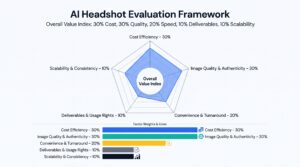
How we ranked your options
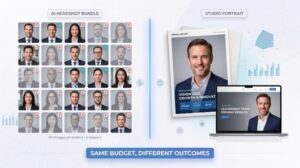 First, cost efficiency. We look at the out-of-pocket spend per usable image, not just the sticker price. A $49 AI bundle that yields only two keeper photos works out to about twenty-five dollars per finished shot, and the bargain starts to fade.
Second, image quality and authenticity. Does the photo look like a confident human or a plastic mannequin? Boards, investors, and compliance teams notice the difference, so quality carries the same weight as cost in our formula.
Convenience and turnaround come next. Busy leaders will pay more to skip travel, avoid scheduling traffic jams, and receive finals in under forty-eight hours. We give extra credit to services that deliver fast without cutting corners.
Deliverables and usage rights matter too. One provider hands over a single low-res JPEG; another supplies five retouched, full-resolution files with unrestricted licensing. The latter scores higher because you avoid surprise fees when marketing wants a billboard later.
Finally, scalability and consistency. Photographing one founder is easy. Shooting two hundred dispersed employees is another game entirely. We reward platforms that keep style uniform and costs predictable as headcount climbs.
We weight each factor at 30 percent for cost, 30 percent for quality, 20 percent for speed, 10 percent for deliverables, and 10 percent for scalability, then roll them into an overall value index. That index lets us rank all five packages from strongest to weakest. You’ll see the full scorecard right after we dive into the first option.
- AI-powered headshot generators
Independent testing echoes the hit-rate problem. In a 2025 six-tool benchmark that InstaHeadshots published, its own model produced a face-similarity variance of just 0.357 across 200 outputs—roughly one-third of the spread seen in rival generators—so users had to sift through far fewer throwaway frames to find their “keepers.” That tighter quality band helps cap the effective cost per usable image even when you’re drowning in volume.
What it costs and why the sticker price lies
Most AI platforms advertise a flat fee between $29 and $79 per person. At first glance that feels like lunch money next to a $400 studio bill. Capturely’s 2026 market scan confirms the range and even shows enterprise plans dipping below $30 when you buy in bulk.
TeamShotsPro’s launch release pushes the promise further, saying companies save 85 to 95 percent versus traditional photography once headcount climbs.
That sounds impressive until we factor in usability. Independent reviewers report that only 10 to 50 percent of the generated images look realistic enough for LinkedIn or a press kit. A $39 bundle that spits out 50 files might leave just five keepers, so your real cost per usable photo jumps to about $7.80.
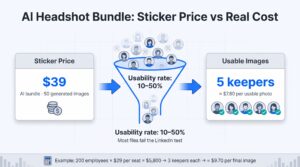 Volume pricing tells a similar story. A 200-employee rollout at $29 per seat looks like $5,800 all-in, but if each person downloads three acceptable shots, the spend per final image hovers around $9.70. Cheap, yet no longer the 95-percent miracle the headline hinted at.
What shows up in your download folder
An AI session lives entirely in the cloud. You upload ten to twenty casual selfies, click “Generate,” and watch a progress bar. Some platforms deliver near-instant results; InstaHeadshots team headshots claims it can turn raw uploads into studio-quality portraits in just fifteen minutes after learning your facial features and has already produced more than 36 million images for corporate clients. Whether it is fifteen minutes or a couple of hours, a zip file soon lands in your inbox packed with brand-new portraits.

Quantity isn’t the problem. Most services promise 20 to 100 images in multiple lighting styles, backgrounds, and crops. They also grant broad usage rights by default, since no human artist claims copyright.
Quality is the catch. Test runs show that only a sliver of those files pass the “Would I post this on LinkedIn?” test. Faces can look too smooth, eyeglasses disappear, jewelry warps, or clothing folds blur into digital mush. The platforms know this, so they play the volume game-one great frame buried in a pile of oddities still feels like a win when the sticker price is low.
Corporate buyers value consistency even more than beauty. Here AI quietly delivers. Because the engine applies one template to every face, a 50-person leadership grid comes back with identical crops, lighting, and branded backdrops. Compare that with sending employees across three cities to three different photographers and you see why finance teams pay attention. TeamShotsPro highlights enterprise clients trimming headshot budgets by up to 95 percent because machines never submit travel receipts.
Speed is another upside. When a new VP signs her offer letter on Monday, HR can add her polished portrait to the website before Friday’s press release. No other method turns raw selfies into executive-ready imagery that fast.
So you get speed, volume, and uniform styling. You trade away human nuance. Whether that swap makes sense depends on how sensitive your brand is to authenticity.
Where AI wins and where it falters
The case for AI starts with efficiency. Upload selfies over lunch and you often receive finished portraits before the afternoon stand-up. Finance teams also like the math: TeamShotsPro’s February 2026 launch touted savings of up to 95 percent compared with flying in a photographer.
Consistency joins speed on the plus column. Because an algorithm applies identical lighting, crop, and branded backdrop to every face, a 50-person leadership page looks freshly ironed—no rogue shadows or mismatched color temperatures.
Authenticity is the trade-off. Industry reviews note that only 10 to 50 percent of generated shots survive a real-world quality check. Viewers sense something off in the others: porcelain skin, asymmetrical eyes, collars that melt into the background. Those tells erode trust faster than a bargain restores it.
Policy can be a deal breaker too. Regulated firms in finance, healthcare, and government are starting to flag AI portraits as non-compliant because the image is technically a fabrication, not proof of a real session. If your legal team needs photos that stand up to due-diligence scrutiny, a synthetic headshot raises red flags.
Bottom line: AI generators excel when speed, budget, and uniform branding outrank absolute realism. The closer your role is to investors, journalists, or high-ticket clients, the more the authenticity gap matters.
- Virtual headshot sessions
What it costs and the hidden variables
Virtual photography sounds high-tech, yet the pricing stays refreshingly grounded. A self-guided platform usually lands between $25 and $60 per person. Bring in a live photographer who coaches you through your phone, and the ticket rises to $45–$79, still a fraction of a studio day. Capturely’s 2026 pricing grid shows both brackets.
At first glance the model looks simple: one fee, one edited image, done. The fine print changes the math. Some services limit you to a single retouch; extras run ten to twenty dollars apiece. Others add a processing charge for enterprise dashboards or encourage a subscription for long-term storage. These upsells don’t wreck the budget, but they nudge the per-image cost closer to traditional territory if you’re not watching the checkout screen.
Equipment is another variable. The platform supplies software and human guidance, yet lighting, camera quality, and backdrop still depend on the user’s space. Companies serious about uniform results often mail employees a $30 ring-light kit or reimburse a basic phone tripod. The gear is inexpensive, but it still hits the ledger.
Add it up: a $60 live-guided session plus one extra photo and a ring light can reach about $100. Still thrifty compared with a $400 studio slot, but no longer the bargain the headline promised. The next section looks at what that hundred dollars buys in authenticity and brand control.
What you actually receive
A virtual session produces real photographs, not digital approximations. You connect through a web platform or mobile app, position your phone or webcam, and a photographer guides you live: tilt your chin, relax your smile, step closer to the window. They trigger the shutter remotely, capturing a burst of frames that feels close to an in-person shoot.
 Within twenty-four to forty-eight hours an editor retouches the winning frame, cleaning stray hairs, balancing color, and swapping in a brand-approved background if you request one. You usually pick your favorite shot from a short proof gallery, so you stay in control of the final look.
Most packages include a single high-resolution JPEG ready for LinkedIn, Slack, and press releases. Need a square crop for Teams or a transparent PNG for keynote slides? That request is often handled the same day at no extra charge. Larger teams also get an online dashboard where HR can track progress, download files in bulk, and order re-edits without email chains.
Turnaround speed sits comfortably between AI instant gratification and studio pacing. You skip calendar juggling and travel time yet still benefit from a professional’s eye. In short, you give up a bit of autonomy by following lighting instructions, but gain a polished, authentic photo that feels human and brand-consistent.
Strengths, weaknesses, and best-fit scenarios
Virtual sessions shine in distributed teams. Everyone books a fifteen-minute slot, steps away from Slack, and returns to the calendar with a polished headshot forty-eight hours later. No travel, no studio nerves, no wasted payroll while people wait in line for lights to reset.
Authenticity stays high because the camera captures your face in real time. A pro on the other end of the call coaxes natural expressions, something AI can’t yet fake convincingly. Firms in regulated spaces appreciate that the final file is an honest photograph, not synthetic data.
Consistency is also strong. The editor can drop a single hex-code backdrop behind every employee, lock crop ratios, and balance color temperature so the leadership page feels unified. That brand control rivals what you get from an on-site photo day without the logistical circus.
Where does the model stumble? Technical quality lives or dies by each participant’s setup. A dimly lit apartment or a scratched webcam lens will show. Some platforms mail ring lights, yet success still hangs on users following prep instructions. If even ten percent of your staff ignores the guide, their photos pull down the overall aesthetic.
There’s also a ceiling on artistry. Virtual shoots deliver clean, functional portraits, but they rarely produce the kind of magazine-worthy image a CEO wants for a keynote backdrop. If your C-suite wants cinematic lighting and creative angles, a physical studio still wins.
Choose virtual when you need fast, authentic photos for a geographically scattered workforce and you’re comfortable enforcing a simple at-home lighting checklist. Pass if top leaders demand a level of polish that only glass optics and studio strobes can provide.
- On-demand freelancer marketplaces
What it costs and the reality behind the bargain
Browse Snappr, Thumbtack, or Upwork and you’ll spot headshot offers starting at $60 for a thirty-minute shoot. In major metros the median climbs to $150–$200, still friendly compared with a studio session. Many listings promise quick turnaround, with edited files in forty-eight hours, and throw in a couple of free extra poses if you book this week.
Marketplace economics push those stickers down. Photographers compete in real time, so prices fall until someone blinks. That auction dynamic helps buyers on paper, but it also means you’re betting on whichever freelancer was free that afternoon. Skill, gear, and reliability span a wide range.
Add-ons appear quickly. The headline rate often includes one retouched JPEG. Want a second look, deeper skin retouching, or a transparent PNG for keynote slides? Expect $20–$50 per extra. Some shooters charge travel or parking when they learn your office sits across town. By the time you collect three finals and pay incidental fees, the per-person spend can climb past $250.
Yes, marketplaces can deliver genuine savings, especially in smaller cities where local studios are rare. Just remember that the rock-bottom quote rarely tells the full budget story. In the next subsection we’ll see what arrives after you click “Book now” and how to separate hidden gems from misfires.
Deliverables, variability, and risk control
When the freelancer shows up—sometimes a seasoned pro, sometimes a hobbyist with a used DSLR—you get a fast shoot. Expect a tight thirty-minute window, a portable flash, and maybe a wrinkled gray backdrop pulled from a duffel. The upside is genuine optics: glass lenses, real lighting, and depth of field your phone can’t match.
After the session the photographer emails a proof gallery, often the same evening. You pick your favorites, they retouch, and files land in your inbox within a week. The average booking includes two to three edited JPEGs in high resolution, enough for LinkedIn, the press kit, and a speaker bio. Licensing is usually generous; most freelancers grant unlimited business use because chasing royalties isn’t worth their time.
Quality, though, rides a roller coaster. One Snappr contractor might nail Rembrandt lighting and crisp focus, while another misses half the frames. Marketplace ratings help, but star scores skew high because clients hesitate to ding a friendly local shooter. To hedge, ask for a full-resolution sample before you sign, confirm how many edits are included, and put retouching turnaround in writing.
In short, on-demand marketplaces provide a quick path to professional-looking photos on a modest budget if you invest twenty minutes vetting the person behind the lens. The model falters when you need absolute consistency across offices or firm scheduling. For that, we move next to the traditional studio route.
- Traditional studio photographers
What it costs and why the premium pays off
Walk into a dedicated portrait studio and you trade discount pricing for white-glove control. A basic executive package runs $150–$300 for a half-hour shoot and one retouched file. Step up to a standard hour with outfit changes and five finals, and the ticket climbs to $300–$600. Top-tier branding sessions, complete with a makeup artist and multiple sets, break the $1,200 mark without hesitation.
Those figures cover more than shutter clicks. You’re paying for decades of lighting craft, calibrated color workflows, and gear that costs more than a company car. Add-ons appear, but they’re visible: travel to your office, rush edits in under forty-eight hours, or extra image licenses for a national billboard. Because studios publish rate cards up front, you face fewer surprise fees later.
Sticker shock fades when you amortize quality over use. A flagship CEO portrait can headline annual reports, investor decks, keynote slides, and media interviews for three to five years. Spread a $600 fee across that lifespan and the cost per impression drops to pennies, often cheaper long-term than rolling the dice on lower-priced options that need constant replacement.
Next, we’ll peek inside the studio experience to see what you receive for that premium and how the results differ from every approach we’ve covered so far.
Inside the studio experience
A studio shoot feels different the moment you walk in. A producer greets you, hangs your blazer, and hands you coffee while a makeup artist smooths fly-aways. The photographer then guides you onto a set tailored for executive portraits: large soft boxes for flattering wraparound light, a backdrop that matches brand colors, and a tethered monitor so you can review images in real time.
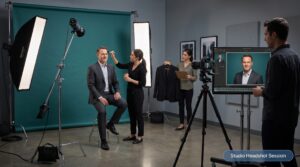 That instant feedback loop is the studio’s secret sauce. You see frame one, tweak your tie, adjust posture, and by frame five the shot already exudes confidence. Because the photographer controls every photon, small changes in chin angle or catch-light placement translate into a measurable bump in perceived competence; tests show increases as high as 76 percent. The result is a portrait that holds up on a billboard and under harsh conference-hall lighting.
After the session you receive a proof gallery, often fifty to eighty images, within twenty-four hours. You pick your favorites, and a retoucher removes stray hairs, whitens teeth, and erases lint pixel by pixel. Final files arrive in multiple crops and color profiles: CMYK for print, sRGB for web, and a transparent PNG for slide decks. You own broad usage rights, so marketing can drop the image into next quarter’s investor deck without chasing extra licenses.
That level of control and craft is why seasoned executives and high-visibility founders still budget for studio time. For marquee roles, one perfect headshot is brand insurance you can see.
- On-site “photo day” packages
What it costs and how bulk pricing works
When you need fifty new headshots before a website relaunch, bringing the studio to your office beats herding staff across town. Photographers quote these gigs in two common ways.
- Per-person fee plus setup
A crew rolls in with lights, a backdrop, and a tethered laptop for instant review. You pay a flat setup, often $500 to $1,000, then $50 to $150 per employee. Photographing forty teammates at one hundred dollars each totals roughly $5,000, including one fully retouched file per person. - Day-rate model
Some pros prefer simplicity. $3,000 to $5,000 buys an eight-hour block that covers as many people as the schedule allows, typically sixty to eighty heads when slots run ten minutes apiece. Effective cost per person slides under $80 if you fill the calendar.
Either structure feels steep until you compare it with sending everyone to individual studios. A fifty-person leadership page shot separately at $400 each would burn $20,000. An on-site package trims that bill by 60 to 75 percent while locking in a consistent backdrop and lighting style.
Workflow, consistency, and common pitfalls
A conference room becomes a mini studio. Lights pop up in one corner, a laptop shows live previews, and employees cycle through in five-minute blocks. Each subject reviews thumbnails on the tethered monitor, picks a favorite on the spot, and heads back to their desk. That instant selection cuts post-shoot email traffic and ensures retouchers work on the exact file each person approves.
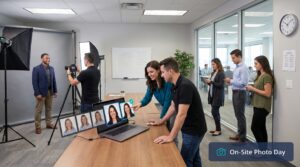 Uniformity is the headline benefit. Every headshot shares the same height, crop, and background hue. Marketing can drop them into a team grid without tweaking exposure or white balance. For rebrands, a photographer simply swaps the backdrop fabric and keeps shooting, with no template updates or AI retraining required.
Speed follows close behind. A seasoned crew can photograph more than sixty people in a single day and deliver retouched images within a week. Compare that with chasing individual bookings and you save not only dollars but dozens of project-management hours.
Still, the assembly-line pace has downsides. Some employees need time to relax in front of a lens, and ten minutes may not cut it. A late arrival or tech glitch can also snowball, leaving the schedule in tatters by lunch. Mitigate that risk with buffer slots and a point person who corrals stragglers.
Quality stays high for clean, straightforward portraits, but you sacrifice creative flair. If executives want environmental shots in the lobby or dramatic cross-lighting, book them a separate studio slot. Photo day is about efficiency, not artistry.
Choose an on-site package when headcount and brand cohesion outweigh individual expression. Steer clear if you need bespoke images or run a fully remote model where no single office hosts the full team.
Frequently asked questions
What should we actually budget per usable photo?
Budget on keepers, not on files delivered. AI bundles advertise $29 to $79 per person, but with only 10 to 50 percent of outputs passing a real quality check, a $39 pack of 50 images that yields five keepers works out to roughly $7.80 each. Virtual sessions land near $100 all-in once you add an extra retouch and a ring light, freelancers can pass $250 by the time incidentals clear, and studio work runs $150 to $1,200-plus. The cheapest option per file is rarely the cheapest per photo you would actually publish.
Can we mix approaches across one company?
This is usually the right answer, and it is what most brand-conscious teams settle on. Put the C-suite and anyone facing investors or press through a studio session, then run the broader workforce through AI or an on-site photo day. The one rule is to standardise the backdrop and crop across both tiers, otherwise the leadership row and the team grid will read as two different companies.
Will AI headshots create compliance problems for us?
Potentially, and it depends on your sector. Regulated firms in finance, healthcare, and government are beginning to flag AI portraits as non-compliant on the grounds that the image documents no real session. If your photos may be pulled into due diligence, KYC processes, or regulatory filings, ask legal before you buy rather than after, and default to a genuine photograph for anyone whose likeness carries that weight.
How often should executive headshots be refreshed?
A strong studio portrait carries an annual report, investor deck, and keynote slides for three to five years, which is what makes the higher fee defensible on a per-impression basis. Refresh sooner after any material change in appearance or role. For general staff, the cadence usually follows the hiring calendar instead, which is why non-expiring credits and repeatable on-site days matter more than one-off quality at that level.
At what headcount does an on-site photo day beat individual bookings?
The crossover arrives faster than most teams expect. A fifty-person page shot individually at $400 each runs about $20,000, while an on-site package covering the same group lands 60 to 75 percent lower. The day-rate model gets attractive around sixty to eighty people, since filling an eight-hour block pushes the effective cost under $80 per person. Below roughly twenty people in one location, the fixed setup fee usually keeps individual bookings competitive.
What is the single biggest cause of a disappointing rollout?
Not the vendor, but the inputs and the prep. AI results collapse when people upload ten near-identical selfies from one afternoon, and virtual sessions collapse when even ten percent of staff ignore the lighting checklist. Both failure modes are cheap to prevent with a one-page brief and expensive to fix afterwards, since most platforms charge a credit or a re-edit fee for a second attempt.
Conclusion
Five routes, and the honest way to choose between them is to ask what your photos have to survive.
If they only need to look clean in a team grid and the priority is speed and budget, AI generators do that for single-digit dollars per usable image, provided nobody in the set is investor-facing. If your workforce is scattered and you want genuine photographs without travel, virtual sessions hit the middle ground at roughly $100 a head. Freelancer marketplaces make sense for one-off needs in cities where studios are thin, as long as you spend twenty minutes vetting the portfolio first. A traditional studio remains the only option that reliably produces a portrait fit for an annual report cover, and amortised over three to five years the fee is smaller than it looks. And when you need fifty consistent images before a relaunch, an on-site day beats individual bookings by 60 to 75 percent.
Most companies should not pick one. Send the handful of people whose faces carry the brand to a studio, run everyone else through the cheapest route that clears your quality bar, and lock the backdrop and crop across both so the website still looks like a single company. Then judge whatever you chose on cost per photo you would actually publish, because that is the only number that survives contact with the download folder.