As far back as the 1950s, no-parking rules along the streets of The Manors enclaves in the village of Sleepy Hollow went more or less unenforced.
That came to a halt April 22 when a new village ordinance went into effect limiting parking to three hours from 9 a.m. to 6 p.m. Monday through Saturday in Philipse Manor and allowing unrestricted parking outside of the hours of 1 a.m. and 6 a.m. in Sleepy Hollow Manor.
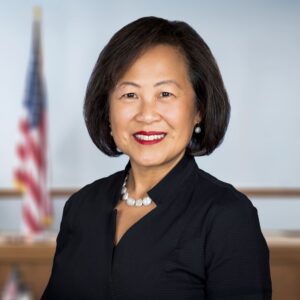
The ordinance, which passed the village Board of Trustees by a 6-1 vote on April 7, is intended to address leftover issues from previous administrations, Mayor Marjorie Hsu said.
“For decades parking was prohibited in Philipse Manor and Sleepy Hollow Manor and now we’ve legalized parking so that people and their visitors can legally park by their homes,” she said.
The mayor said the ordinance will remain in place through January 2027 “so that we’ll have a sense of [residents’] lived experience and if there’s a better solution, we’re open to hearing it.” At that time, trustees will determine whether to keep the rules in place or modify them.
“Our objective is to enforce parking rules equitably and fairly across all of the neighborhoods,” Hsu said.
The village also may implement “targeted, temporary parking measures” during the Halloween season when tens of thousands of visitors flock to Sleepy Hollow, she wrote in a letter to Philipse Manor residents.
The ordinance arrives as state home rule legislation lingers in Albany that would give trustees the right to require parking permits for several sections of the village. This option was originally intended to affect Edge-on-Hudson waterfront luxury residences and the village’s downtown, with Philipse Manor added due to its proximity to the train station.
“We believe that between local ordinances and home rule authority, it gives us options to allow people to park by their own homes while preserving the quality and character of each of our neighborhoods,” Hsu said.
Philipse Manor with about 350 homes, and Sleepy Hollow Manor with some 200 homes are neighborhoods of older houses where the median sales price is about $1.4 million.

Trustee Jim Husselbee, who cast the lone vote against the new ordinance, said the rules were adopted without adequate parking and safety studies or analysis by the village. He also said more public engagement was needed.
Husselbee, a 25-year resident of Sleepy Hollow Manor, called the ordinance an overreach for two neighborhoods where residents had enjoyed “fifty-plus years of peaceable parking rules with largely no safety issues, not a lot of concerns.”
He called the new rules “a terrible solution looking for a problem” and were driven by political concerns over inequity.
“We’ve had the same reasonable ability to park in front of our houses,” Husselbee said. “There’s never been a problem. You talk to people who’ve been here 40, 50 years. There’s never any issues.”
The mayor said the ordinance was adopted following a public hearing, comments submitted via email, surveys by the Philipse Manor Improvement Association and recommendations from the Sleepy Hollow Manor homeowners’ association.
“We are absolutely tailoring the parking rules to the neighborhood,” she said. “We are not putting meters on the streets of Philipse Manor the way they do downtown. In every neighborhood we’re trying to take into account the parking requirements of the residents because at the end of the day we’re trying to make parking easier for residents.”
Darren Mitchell, a 10-year Philipse Manor resident, supports the new ordinance and is open to permits if required.
“So far, that’s worked fine for me,” he said of the three-hour limit. “It’s been a lot better. I just have to make sure not to leave my car out for too long.”
Mitchell, who’s married with three young kids and in-laws who visit frequently, said his neighborhood’s “geographic privilege” of nonenforcement was unfair.
Home Rule Debate
The home rule legislation is before committees in both the state Assembly and Senate and will be amended to include Philipse Manor, according to state Assemblywoman MaryJane Shimsky‘s chief of staff, Pascale Jean-Gilles. The law requires that at least 20 percent of the spaces within the permit area be available to nonresidents.
Permits have support among downtown residents like Jaime Quackenbush, who moved to the village in 2022 from Brooklyn.
“I feel particularly during fall when Sleepy Hollow becomes a tourist destination, but even in general there’s a serious lack of parking,” Quackenbush said. Municipal lots near her home are full and have waiting lists, she said.
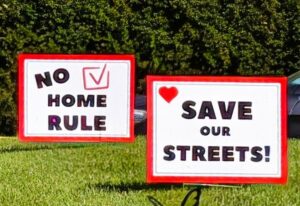
But the inclusion of Philipse Manor has riled some in the enclave, where lawn signs carrying the messages “No Home Rule” and “Save Our Streets!” have popped up.
Robert Welch submitted a petition said to contain 342 signatures opposing his neighborhood’s inclusion in the home rule application.
His Feb. 10 letter to Shimsky and Sen. Majority leader Andrea Stewart-Cousins states that “Philipse Manor does not have an excess of traffic hazards, congestion, air and noise pollution resulting from a purported lack of residential parking.”
The letter states there have been “no resident, vehicle and traffic, or impact studies, nor any implementation plans, commissioned or completed, with regard to Philipse Manor’s inclusion” in the home rule bills.
It goes on to state that Philipse Manor has adequate off-street and overflow parking and has no problems during tourist season.
Permit parking, the letter claims, would “increase both hazards to pedestrians, and the occurrence of vehicle accidents” and “will introduce transient and commuter traffic into and through residential Philipse Manor streets, which were neither designed, nor intended to be used, for thru-traffic needs.”
Mayor Hsu said Philipse Manor was included in the resolution to preserve the option of resident permit parking, if local ordinances didn’t fully address their needs.
“With myriad concerns about commuter parking, and [Welch’s] prediction of Yankee fans parking here and returning inebriated, the Board of Trustees feel resident permits and permits for residents’ guests are a good tool to preserve for Philipse Manor,” she said.
Hsu said she planned a follow-up meeting on May 8 with Welch and others to come up with a consensus among Philipse Manor residents regarding parking.