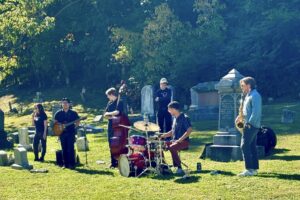



A steep, narrow road winds uphill from Quaker Bridge Road in Cortlandt to a century-old estate modeled after a quaint European farmstead.
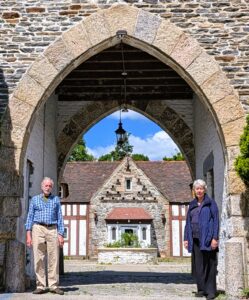
A towering archway opens onto a cobblestone courtyard surrounded by a stone- and wood-framed stable capped with a clay tile roof built for J.M. Kaplan, who owned Welch’s Grape Juice and later became a prominent philanthropist.
The 48-acre property, in the Teatown area near the Croton-on-Hudson border, is entering a new chapter this summer, after the Danish Home for the Aged sold the estate to the Gurdjieff Foundation of New York in 2023.
The Danish Home closed in 2020 after 75 years and the property was listed for $2.9 million.
The Gurdjieff Foundation is using the property for gatherings that follow the teachings of G.I. Gurdjieff, a philosopher, spiritualist and composer whose practices encourage awakening a higher state of consciousness.
The Manhattan-based nonprofit describes itself as “a diverse community of people with the common purpose of living a more conscious and balanced life” through activities “organized to deepen each person’s search in the midst of everyday life while supported by a community of fellow seekers.”
The property’s 20,000-square-foot, two-story main building, renamed the Croton Study House, formerly held the assisted living facility. It can accommodate up to 80 people for meetings, movement practices, music and meditation.
The expansive Oak Room, with its wood-beamed cathedral ceiling, is the Study House’s crown jewel.
During an early June visit with two of the foundation’s trustees, finishing touches were being applied in preparation for this summer’s visitors. The property is only open to members although events inviting the public are on the horizon.
In a small meeting area named the Arch Room, Diane DelVecchio and Tom Manning — both of whom have been part of the community for some 50 years — said the foundation chose to relocate from Sullivan County to be closer to its membership, most of whom live in New York City and its suburbs.
The facility’s large kitchen and two-dozen bedrooms were well suited to their needs; besides adding sprinklers, painting, tearing up carpets and refinishing floors, little needed to be done to the property.
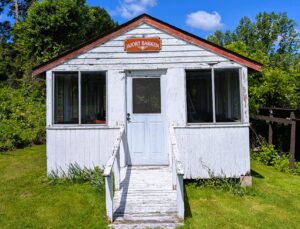
The estate also contains a caretaker’s cottage, barn, crafts studio, a garage and several small kiosks used during the former owner’s Danish Independence Day celebrations. A small shed named Hjort Bakken (Deer Hill in Norwegian) overlooks a pear and apple tree orchard.
“It’s in a neighborhood but it’s isolated, so we’re not that visible. We’re not impinging on the neighbors,” Manning said. “Having a place where you can actually move around more, where you are in closer contact with the natural world, has always been beneficial from our perspective.”
Both trustees spoke of Gurdjieff’s philosophy of achieving a greater degree of consciousness that drew them to his teachings and would be the focus of activities here.
“This is not new but it is certainly even more challenging today,” Manning said. “We live in a world that tends to narrow our sphere of attention.” In settings like their new home, he said, members explore ways of finding a deeper consciousness.
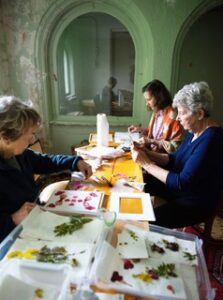
For DelVecchio, the journey of self-discovery through Gurdjieff’s teachings “is very much a work of practice.”
“The pull of life is so strong. We need a school, and this is a school,” she said. “And over time for me, I feel externally I haven’t changed very much. I mean, I’m getting older, but there has been inner growth, which is very hard to explain what that is. But there is a different sense of oneself, and I think that’s what we’re searching for.”