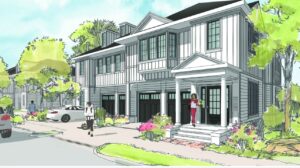
Welcome to Renaissance Briarcliff Manor, once home to Pace University, which is “being reimagined as a residential community that reflects the character and charm of Westchester living.”
That’s the pitch on the newly launched website from developer Leonard Glickman, whose Rose Enterprises has applied to build 110 luxury townhouses and five single-family homes on the site.
“Designed with a sense of connection to its surroundings” the website states, the development “blends thoughtful architecture, open green space, and a respect for the area’s history to create a setting that feels genuinely part of the community.”
Rose Enterprises is in contract to purchase the 37-acre campus from Yeshivath Viznitz Dkhal Torath Chaim, contingent on receiving the approvals needed to move forward with the estimated 18-24-month project.
The village’s Board of Trustees set a public hearing for Tuesday, Nov. 18, at 7:30 p.m. on the proposal, which would also require vetting by the Planning and Architectural Review boards.
The vacant Elm Road campus is zoned to allow single-family homes and would need rezoning to a yet-to-be-approved Planned Unit Development designation to allow townhouses.
The townhouse development would include 10 acres of open space, landscaped buffers, walking trails, a pool with a clubhouse, all within walking distance of the village’s downtown.
The two-, three- and four-bedroom units would be taxed at full value rather than at the 75 percent rate that condominium owners in the village pay. The single-family homes fronting Tuttle Road would each be custom-built.
Renaissance Briarcliff Manor would put the campus back on the tax rolls to the tune of an estimated $5 million annually, $1 million of which would go to the village and $3.3 million to local schools. All 10 vacant buildings on the campus would have to be demolished.
‘This train is in motion’
A presentation by Glickman’s representatives at the board’s Oct. 21 meeting left Tuttle Road resident Casey Malone with the impression the plans were further along than neighbors realized.
“There’s a lot of people in the surrounding area that are not even fully aware that this train is in motion, a significant number, so maybe the town wants to put notices in mailboxes to just explain what is happening,” she said during the meeting’s public comment portion.
Malone said residents would welcome an opportunity to meet with the developer “to really speak about what is important to us who live in the community and have lived in the community for so many years and have made it what it is.”
Glickman has said he plans to meet with neighbors to discuss their concerns.
Mayor Steven Vescio responded that an extensive review process was just beginning, and that property owners within 500 feet of the campus would be informed by mail about the upcoming public hearing. Updates would be provided in the village’s weekly email blast and concerns could be sent to the board via email.
Vescio assured Malone that the approvals process would provide “a lot of opportunities for public input.”
Ongoing saga
The proposal is the latest chapter in a saga that began when the Monsey-based congregation bought the property for $11.5 million in 2021.
The yeshiva requested a special permit to operate a school for hundreds of college-age men, but filed a federal lawsuit against the village in 2023 claiming religious discrimination after two years of hearings that didn’t result in approvals.
In December 2024, the village and yeshiva reached an agreement to suspend litigation and explore alternative uses of the campus, including residential uses.