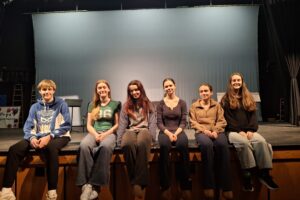





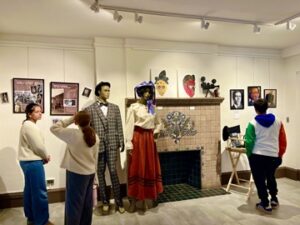
 Briarcliff Middle School seventh and eighth graders recently had the opportunity to explore the history of Blacks in America in an exhibit that presents the contribution of Black Americans in society in an effort to break down stereotypes.
The exhibit, at Bethany Arts Center in Ossining, was titled “Revolutionary Legacies” and honors the spirit, resilience and representation of Black Americans in the American Revolution, something that continues to shape our culture.
The exhibit was presented in conjunction with both National Black History Month and the 250th Anniversary of the Declaration of Independence.
Students visited all nine galleries with a docent, who explained many of the paintings, artifacts and replicas.
Seventh graders with Chris Quinn are studying the Revolutionary War, as well as the Civil War, in class this year.
“The exhibit ties in well with our unit because it highlights the Declaration of Independence, as well as the 13th Amendment about abolishing slavery,” Quinn said.
“Students were very focused and engaged,” he said. “I told them to try and remember one item in each room and later in class, we had a trivia game about those items.”
The exhibit also ties into the eighth-grade curriculum.
“This year we are learning about events after the Civil War through Reconstruction, the Jim Crow era and the Civil Rights Movement, up until today,” said Social Studies teacher John Lloyd. “Although the exhibit does not explicitly mention the Jim Crow laws, it does discuss the limitations that were placed on Black Americans and how they resisted those limitations.”
The entrance to the exhibit was a powerful reminder of equality, Lloyd said.
“The very first part of the gallery when you enter, shows the Declaration of Independence with the words ‘All Men Are Created Equal’ prominently displayed,” he said.
Lloyd hoped his students would find aspects of the exhibit to be powerful, so he created an assignment to provide a deeper understanding.
“In the assignment, my students had to select two of the nine galleries in the exhibit and choose one of four ways to demonstrate freedom, which is a theme related to the 250th Anniversary of the Declaration of Independence,” he said. “They had to explain how those two galleries express freedom, and then they had to argue which of those two was more powerful in conveying that.”
Students could express their responses using various means.
“They could either write two paragraphs, write a poem or a story and explain how it relates to freedom; create a piece of visual art with a caption; or they could make a video of themselves explaining their responses.”
Quinn found the photography exhibit very interesting.
“The exhibit displayed photographs of Black Americans showing them dignified and well dressed,” he said. “It discussed the role of photography and how it was used to change the stereotypes people had by showing Black Americans in a different light.”
Lloyd agreed.
“My favorite gallery was also the photograph gallery, especially with the depictions of Sojourner Truth and Fredrick Douglass,” he said. “I liked the idea of Black Americans using photographs to show themselves in a more dignified light than they were typically perceived by society. I also liked how the exhibits were much more interactive this year. Students could sit at a counter, which was a replica of the counter in the diner in the sit-ins, and they could take a photo with a Polaroid camera. There was also music playing in the background. This aspect made it much more accessible for a younger audience.”
Students thought the trip was well worth it.
“I learned a lot about how Black Americans were slaves and became free,” said Max, a seventh grader.
“I liked the counter and the other replicas and artifacts,” said Anya, another seventh grader. “I also liked the mural in the first room that showed Black people and broken chains. That was pretty cool.
“I learned that every race has importance,” she added. “Black Americans invented a lot of things that would not have been invented otherwise.”