


A visit to the eight-acre estate once owned by the business titan who founded the Village of Briarcliff Manor is like stepping back in time to the Gilded Age.
The 15,000-square-foot stone mansion built by industrialist Walter Law in 1898 sits high atop Scarborough Road, home to famed estates once owned by the Astors, Vanderlips and Speyers.
The estate is on the market for $1.9 million, listed by Jamey Gelardi of Houlihan Lawrence.
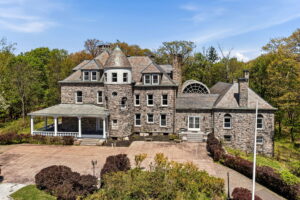
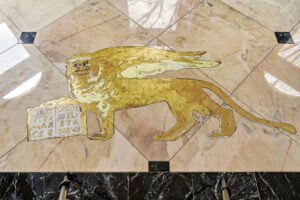
Visitors enter through a driveway flanked by stone pillars crowned by guardian lion statues, a motif carried throughout the house and grounds.
The landscape, conceived with the assistance of the Olmsted Brothers (architects of New York City’s Central Park) features statues, walking paths, waterfalls, retaining walls, gazebos and gardens. The home retains its original slate roof and wrap-around front porch.
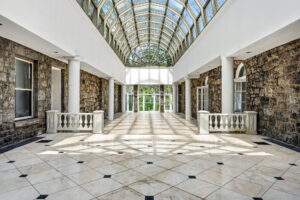
The hand-laid mosaics, marble floors, and hardwood flooring are part of the estate’s original construction. The home comprises more than a dozen bedrooms, 7.5 baths, and an entertainment hall with a wood-crafted bar and glass atrium along with an indoor pool.
Spacious rooms with cathedral ceilings are anchored by 14 fireplaces, with walls dressed in carefully preserved wood paneling imported from the Baxter church in England.
While many of the estate’s classic features remain intact, others require a new owner keen to restore its architecture and history and elevate it to the 21st century.
Gelardi noted the mansion was built “to a scale and size along with a level of craftmanship rarely found these days. It’s amazing to see how well it has been preserved for all this time even after a few years of neglect.”
He added: “I know it will take a discerning buyer with patience and vision to bring this estate back to its original grandeur, and I’m excited to see the end result because I know it will be unique and spectacular.”
Who was Walter Law?
Walter Law, who was born in England, arrived in New York in January of 1860 with “only enough money to last him about two weeks,” according to the Briarcliff Manor-Scarborough Historical Society.
He made his fortune in the carpet trade with the W. & J. Sloane and Alexander Smith & Sons companies and began amassing hundreds of acres in what was then the hamlet of Scarborough to establish Briarcliff Farms.
The farms grew to contain more than 2,500 pure-bred Jersey cattle and 500 workers producing some 3,000 to 4,000 quarts of milk per day, plus other dairy products like cream and butter, according to the historical society.
After failing to incorporate the area around Briarcliff Farms as part of Scarborough, Law submitted a petition to incorporate a new village, eventually leading to the establishment of Briarcliff Manor in 1902.
Law paid for the construction of the still-existing Briarcliff Congregational Church, built schools, and funded equipment for the newly created Briarcliff Manor Fire Department.
In 1902, Law opened the Briarcliff Lodge on Scarborough Road, a resort whose guests included Franklin and Eleanor Roosevelt, Thomas Edison, and Babe Ruth. It later became home to The Kings College. The original building burned to the ground in 2003, and the property is now home to The Club at Briarcliff Manor, a retirement community.
Law died in 1924 at age 86 and was buried in Woodlawn Cemetery in The Bronx.