




Part One (HERE) took a look at how cemeteries can reflect movements and trends since our earliest years as a country. We continue our 250th Anniversary celebration by exploring local cemeteries as a study in American history and culture by describing inscriptions and personalization, an increase in cemeteries-as-arboreta, connections with wildlife preservation, and an examination of the fandom phenomenon.
Messages in Stone, Sound, and Tech
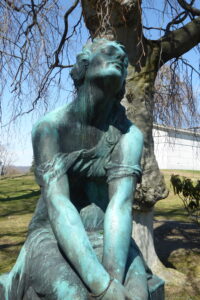
The inscriptions on monuments and markers have evolved over the centuries from cryptic and functional to inside jokes and personal testimonials. The sentiment expressed on one local monument that reads “Maker, I trust what Thou shalt do” has its contemporary counterpart in another local cemetery as “The future belongs to those who plan for it.” Sweet tributes to a loved one can be found with movie references (“Here’s looking at you, kid”) and modern hyperbole (“I love you to the moon and back.”) Inscription details can also reveal clues to where our earliest residents may have traveled from to make their homes here. Look for different languages and the names of hometowns across the Atlantic. And any trip through a cemetery today will also offer stories of professional achievement, heroism in wartime, and descriptions of family tragedy. A monument in Sharon Gardens (Valhalla, 1953) testifies to generations massacred during the Holocaust. A monument in Hillside Cemetery describes a soldier’s last moments at the Battle of Antietam: “No sound can awake him to glory again.” Another cemetery monument points out significant committee work accomplished by a member of Congress.
Most recently, digital technology has created opportunities for personalization through computer-generated portraiture and scenic designs on monuments as well as QR codes that link to family memoirs and photos. Even gravesite décor has expanded as a tool for personalization: You might find burials decorated with wind chimes, bird feeders, or commissioned statuary.
Trees Take Root
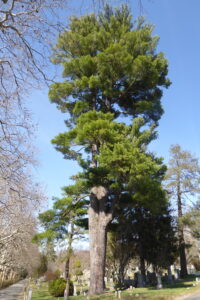
Another recent development is the awarding of arboretum status to cemeteries by ArbNet, the international accrediting body. Rural cemeteries in particular are good candidates for this credential as they have historically treasured their tree collection as part of the commitment to preserve and protect their natural settings. Two cemeteries in Westchester are accredited by ArbNet as arboreta: Sleepy Hollow Cemetery with 25 different species of trees and woody plants has Level I status; Kensico Cemetery, with 100 different species of trees, was awarded Level II status. All levels require public
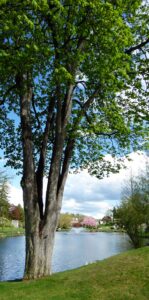
access to the arboretum and educational programming. Look for labels on the trees and invitations to attend events and workshops. The tree collections often include species not native to this area but selected for their ornamental interest, year-round flowering, and resistance to climate and insect damage. To find all arboreta throughout the county and country, go to https://arbnet.org. for a state-by-state listing.
Watching Out for Wildlife
You might expect to see a squirrel, a robin, or even a deer on cemetery grounds, but how about bee colonies, Eastern bluebird nestboxes, and Monarch butterfly waystations? Cemeteries are aligning with agencies whose goal is to protect endangered species, and that has resulted in new structures and dedicated spots on cemetery grounds. The Bronx River Sound Shore Audubon Society, for example, has placed over 300 Eastern bluebird nestboxes in the open spaces at parks, cemeteries, colleges, and golf courses throughout the county. Monitored by volunteers, the nestboxes in cemeteries can be spotted locally in Kensico Cemetery, Ferncliff Cemetery, Gate of Heaven (Hawthorne, 1917), Mount Calvary Cemetery (White Plains,1892), Mount Hope Cemetery, and Mount Pleasant Cemetery (Hawthorne, 1899). Bee colonies and Monarch butterfly waystations are two other pollinator protection projects evidenced in cemeteries today. While the bees enjoy a habitat protected from predators, the butterflies find nourishment from milkweed planted along their migratory path –all contributing to a supportive ecosystem for nature’s needs throughout the cemetery grounds. You can locate or register a Monarch butterfly waystation at https://monarchwatch.org.
Fandom Finds a Forever Home
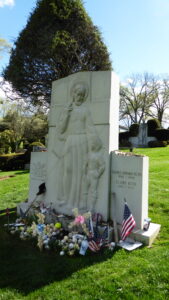
Celebrity-watching has spilled over into the realm of the hereafter as interest in visiting the final resting places of authors, entertainers, politicians, athletes – even notorious criminals and their unfortunate victims – reaches “destination” level. We are familiar with the historical tours conducted at Sleepy Hollow Cemetery, but there are hundreds of cemetery tours and maps nationwide that point out where famous people are buried through self-guided, virtual, and personal tours for taphophiles (cemetery buffs). Locally, baseball fans tour Kensico Cemetery (Lou Gehrig, Jacob Ruppert, Harry Frazee, Edward Barrow) and head next door to Gate of Heaven Cemetery to stop at the gravesites of Babe Ruth and Billy Martin. Curious fans visit (https://www.findagrave.com) where “famous” can be searched for any cemetery, and a list will pop up of notables buried there, often with photos, bios, and tributes. Interestingly, some states have passed – and others are considering – legislation that prohibits the marketing of famous final resting places. So, when planning your fandom expeditions, make sure you have current information on access to gravesites.
Regardless of location, cemeteries will continue to show us how we are growing, how we are changing, and what we still hold true as a culture, a community, and a country. To keep up with the times, consider a walk through your local cemetery. Just hold onto this one thought as you pause at a monument, a mausoleum, a marker, a final resting place: Your stopping by acknowledges in a small way a life lived. And that’s a gift to history.