




Even before the Declaration of Independence was signed in 1776, our oldest cemeteries and churchyards in the River Towns (Old Dutch Church, Sleepy Hollow, 1673); Sparta Cemetery, Ossining,1764;) had already begun to tell our story as a country by leaving clues on markers they left behind and the burial practices they followed. Much has happened in the intervening years that ultimately changed the landscape of cemeteries today – if you know where to look. So, as we celebrate our nation’s 250th anniversary, here is a sampling of the influences and movements that have shaped our history as told by our final resting places.
Searching for Peace and Quiet
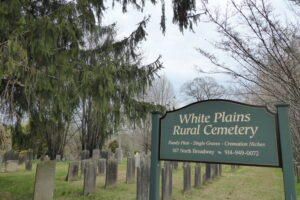
As you approach a cemetery for the first time, notice the layout. Look for winding roads, an abundance of trees, often a water feature, and benches. You may have entered a “rural cemetery” – a classification given to burial grounds rooted in a mid-1800s movement that replaced dark and brooding views of death with Romanticism’s embrace of nature’s beauty. By creating inspiring landscapes for the remembrance of loved ones, rural cemeteries – then and now – prominently feature the natural contours of the land and provide a pastoral setting for families and visitors to enjoy the restorative peace of hillsides, shade trees, and walking paths – away from the noise and distractions of industrialized city life. Local examples include Sleepy Hollow Cemetery (Sleepy Hollow, 1849), White Plains Rural Cemetery (1854), and Kensico Cemetery (Valhalla, 1889). And as it turned out, rural cemeteries ultimately became America’s first parks – not by name or location but, literally, by design.
Finding Fellowship
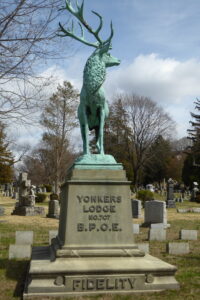
Dating back to the 1800s, fraternal organizations became a popular means for men to socialize around a patriotic, charitable, or academic cause with each organization having its own – sometimes secret – practices, rules, dress, and membership requirements. You would recognize the names of some of the oldest fraternal organizations that are still active today: Independent Order of Odd Fellows (1819), Benevolent and Protective Order of Elks (1866), and Ancient Arabic Order of the Nobles of the Mystic Shrine (1872, now known as Shriners International). Local chapters or “lodges” would often purchase a cemetery lot for their officers and members and erect impressive monuments with dramatic statuary, contributing to a cemetery’s “art gallery.”
When Excavations Inspired Architecture
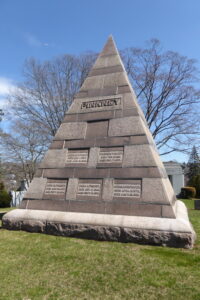
Elements of Classical Greek, Roman, and Egyptian architecture were prevalent in the early 1900s in American mausoleum design largely in response to the public’s fascination with excavations of ancient tombs in the East (think King Tut 1922). These remarkable discoveries were translated into interior design motifs, silent movie themes, and fashion trends, as well as mausoleum architecture that signaled importance and permanence with their Doric, Ionic, and Corinthian columns and massive size, although they often took liberties with style interpretation. Obelisks of all heights and the Greek-temple look became favorites while pyramids were particularly rare. As a matter of fact, there are only a half dozen pyramid mausoleums in New York State, but you can find one at Kensico Cemetery.
Building Up
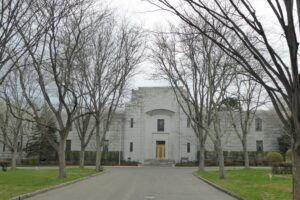
Continued interest in above-ground burials inspired the construction of large community mausoleums in the 1920s where families could purchase a crypt space within a building that encouraged visiting year-round and often included a dedicated area for services. Kensico Cemetery’s Community Mausoleum (1924) and Ferncliff Cemetery’s Community Mausoleum (1928) were among the first in the country and launched a new field in architecture. Sidney Lovell, for example – who designed the Community Mausoleum at Kensico and 55 others in his career – drew on his experiences as the architect for luxury apartment buildings, theaters, and opera houses. Both community mausoleums and columbaria – structures offering above-ground placement of cremains in niches – can create commanding architectural focal points for a cemetery, changing their look forever.
Hunting for Zinkies
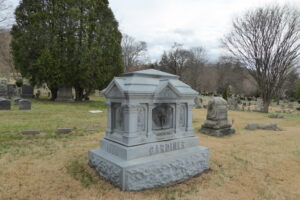
For a short period of time (1874 – 1914), upright hollow monuments made of zinc could be purchased by catalog through the Monumental Bronze Company in Bridgeport, Conn., customized with ornaments and inscriptions, and then shipped for assembly on site. Many cemeteries at that time disallowed them because they were thought to be inferior to stone and likely to deteriorate from decades of exposure. With World War I, the military’s need for metals grew and production eventually stopped, but “zinkies” (as they became known) are still around after 100 years and show little signs of wear. Once you spot one and hear for yourself that clang of hollow metal when gently tapping the surface, you will always recognize its distinctive sound and blue-gray color. Zinkies can be found in the White Plains Rural Cemetery, Hillside Cemetery (Cortlandt Manor,1884), and Oakland Cemetery (Yonkers,1866). You can post a zinkie photo to a Facebook group (“Cemetery Zinkies”) that tracks sightings in cemeteries across the country. Happy hunting!
Discover more ways our local cemeteries tell America’s story in Part Two, coming up in the June issue: Messages in Stone, Sound, and Tech; Trees Take Root, Watching Out for Wildlife, and Fandom: Where Celebrity Finds its Forever Home.
All photos by Judith C. Mitchell