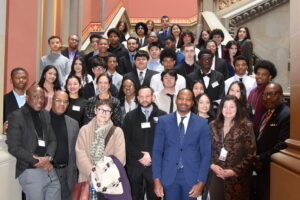
One of this year’s recipients of the Briarcliff High School Distinguished Alumni Award, Class of 1965 alumna Elizabeth Rodgers, recently visited the school to unveil her plaque at the Hall of Distinguished Alumni and to speak with students.
Forty students from several clubs and classes met with her at the amphitheater.
Principal Diana Blank began by describing Rodgers and her work.
“The purpose of the Distinguished Alumni Award is to recognize graduates who have made their mark in ways that inspire our current students and offer a positive vision of the future,” she said. “Elizabeth Rodgers has dedicated her life and career to advocating for human rights, equality and justice. A distinguished employment law attorney, Liz has spent nearly 40 years fighting for employees across all fields, ensuring workplace fairness, equal pay, and protections against discrimination, harassment and retaliation. Recognized as a ‘Super Lawyer’ and a ‘Best Lawyer’ by U.S. News & World Report, she has led groundbreaking cases, shaping employment law at the national level.
“A graduate of Wellesley College, the London School of Economics, and Northeastern University School of Law, Liz has combined her expertise in law and economics to drive meaningful change. She has served as an adjunct professor, legal analyst, and board leader in employment law organizations. Beyond her legal career, Liz is a published poet and co-founder of the Watertown Literary Squad, inspiring others to write and share their voices. At Briarcliff High School, Liz was an editor of Briars and Ivy, foreshadowing her lifelong commitment to amplifying diverse narratives and the arts. Her legacy is one of courage, intellect, creativity and unwavering dedication to justice.”
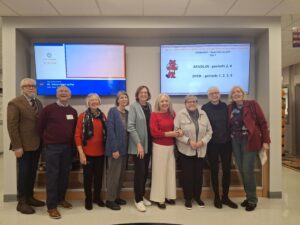
Rodgers, who visited the school along with family members, friends and eight fellow 1965 Briarcliff graduates, began by reminiscing about her time at the school and sharing lessons she has learned along the way.
She spoke of the first time she learned about racism, when she was introduced by a teacher to poets of the Harlem Renaissance by one of her teachers.
“I read aloud Langston Hughes’ poem, ‘What Happens to a Dream Deferred,’ and ‘The Nature of Prejudice,’ and understood for the first time the suffering caused by racism and antisemitism. I was completely unaware of racism before.”
She discussed lessons that shaped her decision to become a civil rights lawyer.
“When I was in third grade at Todd, I was chosen to portray George Washington in the school play and my wig came apart,” she said. “A teacher helped me fix it, and that is when I learned the lesson that things fall apart and that you need someone to help you.”
Rodgers shared stories about people she that represented and fought for, and how she fought against all odds and won their cases.
“I learned to admit when I was ignorant about something, and that it’s important to learn from people who know more than you,” she said.
“My final lesson is: find your voice, join others and help them find their voices. I ended up studying racism and cognitive dissonance and I eventually became a civil rights lawyer. Don’t stay on a path just because you’re good at it; find out what matters to you and then master it.”
She concluded by discussing her biggest influencers.
“I have been influenced by the giants of my generation: Martin Luther King and Ghandi, but my success has been because of my family: my husband, my sister and my friends,” she said. “They are the true VIPs in my life.”
She asked students to turn and look at the people sitting next to them.
“The people you choose to be with – those are the people who will be there for you,” she said.
After the speech, students asked her questions, such as which teacher influenced her. She mentioned several teachers, discussed her civic involvement, shared how she felt when she lost cases that she felt she should have won, and the lessons she learned from making big mistakes.
At the conclusion of the event, she unveiled her plaque at the Hall of Distinguished Alumni.
“There were teachers in this school back in my day who changed my way of seeing the world,” she said. “This has always been a school where ideas matter.”