


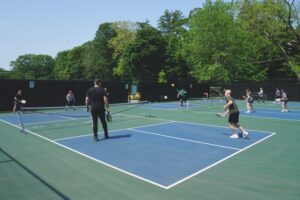
Imagine an amplified ping-pong match running in your living room from 9 a.m. to 9 p.m.—the rapid, plastic pops of paddle hitting ball never stopping. For residents along Chilmark Park, that’s what pickleball has begun to feel like.
The once-quiet neighborhood park in Briarcliff Manor has become the center of a dispute as the village plans to convert two more tennis courts into six new pickleball courts. Homeowners say the sport’s rapid expansion has transformed daily life, while village officials argue rising demand and state grant funding make the project necessary for the broader community.
For Macy Road resident Mary Panico Potente, whose backyard borders the park, the change has been stark. “I used to sit on my deck to read or have dinner,” she said. “Now, on warm days, we hear pickleball from morning until night. It’s constant—the shouting, the cheering, the paddle pops. You can’t open the windows.”
Others describe the sound as inescapable.
Robert Murray, a Farm Road resident who has lived in Briarcliff since 1987, said he recognized the noise immediately because he fought the same battle in Florida, where he spends part of the year.
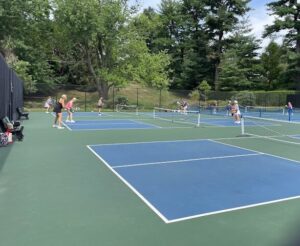
“You cannot escape it,” Murray said. “In Naples, the pickleball courts were 400 feet from my house, and 14 of us had to hire counsel to force our HOA to put up mitigation. When I came home to New York, I heard that same puck, puck, puck and thought, am I hallucinating?”
He contacted village officials soon after. “It was clear to me they had no idea how bad the noise is,” he said. Still, he noted the village has been receptive and he has provided research, letters and a presentation about nationwide pickleball noise conflicts.
“This is a nationwide phenomenon,” Murray added. “The frequency of the hits triggers the body’s fight-or-flight response. People hear tens of thousands of strikes a day. It drives them crazy. None of us signed up for this.”
Chilmark Park, originally part of a private country club dating to the 1950s, remained a quiet neighborhood green space for decades after the village acquired it. Residents say renovations funded by state grants opened the park to the wider public, effectively turning it into a countywide recreation hub without clear communication.
In 2021, the village converted two tennis courts into six pickleball courts. The sport’s popularity quickly drew steady crowds.

Village Manager Joshua Ringel confirmed the courts are busy: “We have high demand, especially in the mornings and in the evenings.” With no lighting, play stops at dusk, but activity remains steady throughout the day. About one-third of players are Briarcliff residents; the rest come from across Westchester.
Residents say the first conversion was disruptive but manageable—until they learned, some by word-of-mouth, that the village intends to convert another set of courts behind their homes. The project is partially funded by a $100,000 grant from state Sen. Pete Harckham but remains in the design phase.
“People feel blindsided,” Panico Potente said. “They keep saying it’s a done deal.”
Homeowners on both the Briarcliff and Ossining sides have organized, raising concerns about noise, property values, nonresident traffic, and the village’s reluctance to consider alternative sites. Recently, 26 families, whose homes surround Chilmark Park, banded together to seek an audience with the Briarcliff Board of Trustees. The result was a meeting with Mayor Steven Vescio down by the courts.
“While Briarcliff has engaged with us on our concerns, it’s clear the train has left the station and now we are left with fighting to ensure what is built in Chilmark Park is ‘simply awful’ versus ‘a nightmare’ for neighbors of the park,” shared Murray.
Some residents have collected decibel readings that they say exceed local noise codes during peak play; one near Knoll Drive reportedly reached 100 decibels. “By any measure, that is a nuisance,” Murray said. Most communities aim for around 60 decibels.
Residents also worry that the noise is disrupting the park’s habitat, noting that wildlife has become noticeably less abundant as the sound levels have risen.

next to the park.
One resident, whose Tudor home sits above the pickleball courts, has retained legal counsel in an effort to stop the Village’s pickleball project altogether. “We’re all rooting for him,” said Murray.
Village officials are actively addressing noise concerns. Ringel said the village plans to install specialized absorptive fencing called SLN/CR around much of the new court area. “The absorptive part was really what attracted us to it because it’s meant to deafen the popping sound,” he said. Feedback from other municipalities has been positive.
However, Chilmark’s courts sit in a small valley, which may present unique challenges. “Most materials only block noise within the line of sight,” Murray explained. “Many homes sit above the courts. Even the best mitigation may not work unless the village brings in an acoustical engineer.”
Ringel acknowledged the challenge of balancing priorities. In addition to the new courts, park improvements are planned, including a permanent restroom to replace porta-potties and a $720,000 state grant to upgrade the playground into an inclusive, all-abilities space.
Construction on the new pickleball courts likely won’t start until summer 2026, with costs expected to exceed the grant. “The village will have to pick up more than 50% of the project,” Ringel said.
The Recreation and Parks Advisory Committee will review updated plans in the coming months, and residents are encouraged to provide feedback and attend meetings.
“Of course, communities and parks evolve,” Panico Potente said. “But this was always a peaceful place. We’re not against pickleball as a sport—we’re against losing our quality of life. All we want is for the village to slow down, look at the impact, and find a location that doesn’t harm people’s homes.”