



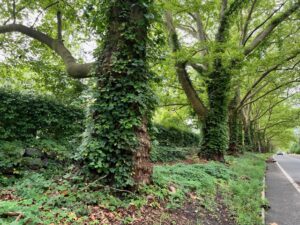
 Last month’s article (accessible at riverjournalonline.com/trees) on the vines throttling our trees generally and those bordering the Sleepy Hollow Cemetery in particular – which are planes, apparently, not sycamores – rang bells with a number of our readers. Clearly Joyce Lannert is not alone in watching and worrying about the damage to our native flora. Others have approached the Village of Sleepy Hollow on this topic; and suggestions have been made about adopting threatened trees, as has been done in other communities.
The Village of Sleepy Hollow’s Tree Commission also reached out, wanting to set the record straight. Erin Carney, chair of the Tree Commission, Char Weigel, a Tree Commission member, village arborist Peter Strom and Kevin Smith, superintendent of the DPW, all spoke to River Journal, delivering the cheering news that the problem of the lovely alley of planes along Route 9 is being tackled.
“We noticed the problem last summer/fall,” Smith explained, “and we spoke to Peter about it and determined that winter would be the best time to start working on it.” Some residents’ comments had been registered in the summer of 2024 and the work started in January 2025.
On the question of who is responsible for the trees, Smith also clarified that the roads are the state’s concern but anything bordering them is for the municipalities to take care of. The state has offered assistance, but “we’re taking responsibility for the trees,” he made clear, adding that the work begun this January will be continued in January 2026 and maintenance continued thereafter.
 “Cutting the vines is the safest way to not damage the trees,” Strom points out, “but it’s an ongoing process.” Repeat work will have to be done perhaps every other year, depending on how fast they grow back. English Ivy is one of the vines attacking the trees, “and that’s something that we wouldn’t want growing up trees.”
“If you drive along you’ll see that the trees on the southern and northern part are free of vines, it’s the ones in the middle that still need to be addressed,” says Weigel.
Carney adds, “That work that was done by the DPW in the winter months was quite noticeable, and it will be again this winter. There were no leaves present. But a number of the vines are poison ivy, and so even a very thin tendril that may have been left will create a very large leaf in the summer season, so that was the optic. It didn’t appear as though they were trimmed to the degree that they were because there were some leaves.”
“The trees are definitely a highlight of driving through Sleepy Hollow,” observes Strom, “and the issue of vines on trees is really horrifying when you drive down the Saw Mill and the Taconic, where they’ve taken over. And the concern is that if we’re not paying attention then that can happen fairly quickly. So the goal is to get to a manageable level of maintenance.”
“The entire Sleepy Hollow Cemetery is an arboretum,” Weigel points out, “so we’re lucky to have that. Certainly the planes are very important to the viewscape and the history of the Village too.”
“I think this conversation has really highlighted the fact that the community is seeing this line of trees as the gateway into the village now,” adds Carney. “It’s lovely that there’s this community ownership and appreciation of these natural landmarks.”
“I think we’ve been struggling to let people know we have heard and the village is taking action,” Weigel says, pointing out that the email addresses below offer communication and a means of dialogue about the trees and sustainable work being done. Plus there’s the village’s newsletter, Sleepy Hollow Connected. “So it would be great, if people are interested, if they would sign up for the newsletter, for example. And then they’ll be alerted to the work of the Tree Commission as well.”