




 As Americans and visitors alike gather across the country to celebrate the nation’s 250th anniversary, the National Liberty Museum invites the public to rediscover one of our most powerful – and often overlooked – rights: the freedom of assembly.
On Friday, March 6, the Museum will debut the first two installations of its groundbreaking exhibition series, “The Forgotten Freedom: American Assembly at 250.”
“Assembly is a fundamental expression of our democracy,” said Dr. Alaine K. Arnott, president and CEO of the National Liberty Museum, “In Philadelphia, where American independence was born, people have long gathered to shape our civic identity. Through artifacts ranging from early handbills to iconic sports history, this exhibition shows how coming together drives change and strengthens our nation.”
Installation one, titled Showing Up Since 1776 — Assembly, Association, Protest, traces the power of gathering as a driving force in American life for the past 250 years. Showing Up Since 1776 explores how people have come together, both formally and informally, to demand change, express identity, build community, and shape the nation’s democratic story. From the fight for independence to the civil rights movement to modern pop culture, the installation illustrates how collective action has continuously moved the country forward.
Visitors will encounter rare and significant artifacts that span eras and generations. Highlights include a chair from the First Continental Congress, representing the earliest American assembly of its kind; a torch carried during the 1936 Olympics, symbolizing the global rise of mass gatherings; and a banner from the 1963 March on Washington, a defining moment in the struggle for civil rights. Sports history also takes center stage, with artifacts from The Miracle on Ice to soccer’s biggest stars, and game-worn jerseys from Philadelphia Eagles icons such as Jalen Hurts, Reggie White, and Chuck Bednarik. Contemporary pop culture pieces also make an appearance, with items from Taylor Swift’s record-breaking Eras Tour, demonstrating how modern fandoms mobilize millions through shared experience.
Installation two, titled The Art of Free Assembly, will allow visitors to experience how artists have captured the intimate moments of gathering that make even the most everyday and commonplace examples of assembly so meaningful. Through their lens, see how this spirit of assembly across generations inspires dialogue and a shared appreciation for the ability to gather.
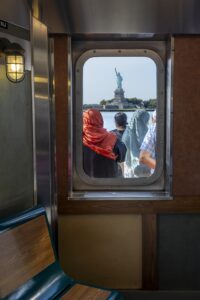
Sleepy Hollow photographer Margaret Fox has an image called Liberty in the exhibit. “’Give me your tired, your poor, your huddled masses yearning to breathe free’ are famous lines from Emma Lazarus’s sonnet displayed on the pedestal of the Statue of Liberty,” says Fox. “The statue is easily visible from the free ferry that shuttles commuters between Lower Manhattan and St. George, Staten Island, one of New York City’s five boroughs. I am drawn to the diverse range of passengers—ethnic, religious, and age groups, among others—hoping to photograph candid moments of humanity. They echo the millions of immigrants processed through Ellis Island in the early 20th century. The island is still visible through the windows. On the busy deck, tourists admire the view and take selfies with the Statue of Liberty in the background. Inside the cabin, most passengers are absorbed in their phones; a couple is engaged in an intense conversation, and I see parents talking with their kids. The small stories unfolding paint a picture of “America”: a reminder of our freedoms as a nation during a time when they are being challenged.
Together, these exhibits trace the story of how Americans have “shown up” to shape history, and invite visitors to consider what assembly means to them today.
The series continues May 8 with Installation 3: 2076 — The Future of Free Assembly, an exploration of how assembly will evolve in digital and physical spaces over the next 50 years.