



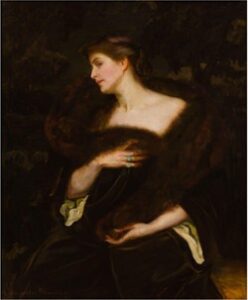
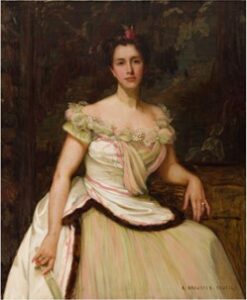
Caramoor Center for Music and the Arts in Katonah, NY, announced the discovery of a complete hidden portrait concealed beneath a painting that has hung in the historic Rosen House for decades. The remarkable find was made by conservator Nadia Ghannam while preparing a circa 1901 portrait of Mrs. Charles S. Dodge (née Flora Bigelow) for treatment.
Both portraits were painted by American artist Amanda Brewster Sewell (1859-1926), and depict the same subject: Flora Bigelow Dodge (1868-1964), mother of Caramoor co-founder Lucie Bigelow Rosen (1890-1968). Amanda Brewster Sewell was an accomplished artist trained in New York and Paris, well-known during her lifetime, whose work has been forgotten in the intervening decades. She was the first woman to receive an award (the Thomas B. Clarke prize) from the National Academy of Design, having been elected an Associate in 1903. Her work featured in numerous early 20th-century exhibitions, including the 1893 World’s Columbian Exposition, where six of her works were exhibited. She was a medal winner at the Columbian Exposition that year, as well as at the Pan-American Exposition in 1901, Charleston Exposition in 1901-02, and the St. Louis Exposition in 1904.
“Finding a second complete portrait beneath the canvas we sent for conservation was completely unexpected,” said Jessa Krick, Director of Interpretation, Collection and Archives at the Rosen House. “Both paintings offer fascinating insights into Flora Dodge’s life during a transformative period, which coincided with her divorce and her evolution as an independent woman at the turn of the 20th century. They are also significant in that they were repeat commissions by a woman from a woman artist, which was very unusual for the time.”
The discovery adds an intriguing layer to the history of Caramoor. Research is ongoing to determine when the earlier portrait was completed and why it was hidden. One possibility is that after her 1903 divorce from Charles Dodge, Flora preferred the more dramatic and seductive pose of the later portrait over the earlier, more formal depiction. Flora Dodge’s story appears as a case study in April White’s 2021 book The Divorce Colony, which chronicles how wealthy New York women traveled to Sioux Falls, South Dakota, in the early 1900s to obtain no-fault divorces, which were unavailable to them in New York. Another theory suggests the double framing may have helped evade customs when Flora sent the painting from London to her daughter Lucie in New York in 1964.
Lucie Bigelow was eleven years old when Sewell painted her portrait, around the same time as her mother’s second portrait. This early exposure to a working female artist appears to have influenced young Lucie, who maintained a lifelong interest in art and artists, seeking out exhibitions of all types and befriending artists in New York and London throughout her adult life.
“The Rosen House has always been at the heart of Caramoor, filled with the music and art the family loved, says Caramoor President and CEO Gillian Fox. “We continue to be intrigued by new discoveries like this one and are honored to conserve and share the House and Collection with the public. We can’t wait for visitors to discover Flora Dodge’s hidden portrait for themselves when they come to Caramoor.”
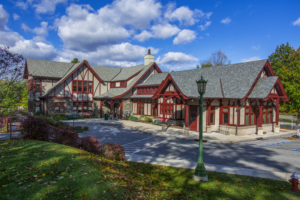
Both portraits are on view in the Rosen House and can be seen during Caramoor’s Holiday Rosen House Tours, running December 10 to 21, 2025 at 12:30pm and 1pm daily (by advance ticket purchase only; no tours on December 15). The art-filled Rosen House is decked out for the holidays with decorations inspired by the Rosen family archive. The House itself offers a number of treasures, including complete 18th-century rooms, originally from private villas and chateaux in Italy, France, and England. The Formal Dining Room features doors thought to have been designed by Giovanni Battista Tiepolo (1695-1770), made for a Venetian palace. The Music Room includes Renaissance furniture and architectural elements such as the intricately carved coffered ceiling from a house in Lecce, Italy; a pair of pink marble twisted columns from Verona, once in the collection of William Randolph Hearst; and a magnificent Franco-Flemish tapestry titled “The Holy Family.”
Caramoor is also producing a short documentary about the discovery of the hidden painting, featuring interviews with experts filmed on location. The film will explore the discovery process and celebrate the remarkable women at the center of this story.
The conservation of the newly discovered portrait was made possible by a grant from the Greater Hudson Heritage Network. A period frame has been acquired and restored by Ammi Ribar of Hudson, New York, to display the newly revealed work alongside its companion piece.