



Planning an itinerary through southern Italy in just one week is no simple challenge. There are too many facets: historical density, landscapes that look like paintings, cities that never seem to exhaust themselves. The temptation would be to extend the stay, to lose oneself longer than the calendar allows, but when time is short, the need to choose carefully arises. And that choice, however limited, opens a journey that can turn into an unforgettable experience.
First encounter with Naples and Pompeii
The logical starting point is Naples, a noisy, intense city where chaos becomes a form of art. In its narrow streets, the air swings between the popular and the solemn: freshly baked pizza coexists with baroque churches that dazzle in silence. It is a place that demands wandering without a set direction, stopping at a market, turning corners that weren’t on the map.
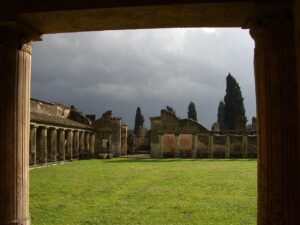
Just a few kilometers away, the scenery changes dramatically. Pompeii offers a brutal contrast: life frozen by the eruption of Vesuvius almost two millennia ago. Walking among mosaics, ruined villas, and human figures petrified by ash produces a strange vertigo, as if time had agreed to stop only there. To experience it without haste, staying near the ruins becomes a fundamental detail. Some travelers choose options such as Il Tesoro Pompeiano, hotel near pompeii ruins, which allow visits to extend beyond tourist hours and to discover a more intimate rhythm, when the sun sets and silence takes over every stone street.
Between cliffs and hanging villages
The journey continues toward the Amalfi Coast. Narrow roads cling to the mountains while below the sea opens in shifting shades of blue. Positano, with its colorful houses stacked on the slope, feels like a postcard in motion. Ravello, perched on a cliff, offers gardens and concerts that still echo through its history. And Amalfi, once a maritime republic, preserves the imprint of its past among cathedrals and squares where the aroma of lemon mixes with artisanal ceramics.
Moving along this strip can be done by car, by ferry, or even on foot, following trails that connect the villages. Each choice reveals a different nuance, and sometimes the best decision is to let chance decide where to stop for dinner or which viewpoint will offer the day’s last light.
Islands that change color
From Sorrento, the crossing to Capri opens another chapter. The island, known for its almost cinematic fame, hides less obvious corners. Just a few steps away from the Piazzetta, paths lead to Villa Jovis or the Arco Naturale, where the sound of the sea replaces the bustle of the center. The Blue Grotto, despite being a tourist cliché, still astonishes: that light emanating from the water itself has something hypnotic, almost unreal.
The sea’s colors shift depending on the hour: from morning turquoise to the deep cobalt of sunset. And when night falls, dining on a terrace overlooking the Gulf of Naples can become a more lasting memory than any souvenir. The feeling of being in a unique setting, changing with each turn of the tide, lingers even when returning to the port.
Matera, where stone tells stories
The itinerary toward the interior leads to Matera, one of the oldest continuously inhabited cities in the world. Its Sassi, neighborhoods carved into the rock, resemble a biblical backdrop, but are also a display of resilience and adaptation. Walking through its steep alleys is like entering a parallel time. At night, with warm lights glowing on the stone, the city takes on an almost dreamlike aura.
Matera requires pausing, listening to the echo bouncing between millenary walls, and accepting that history can be written in overlapping layers. Here, the journey takes on a different tone: less maritime, more introspective, as if the stones kept secrets that only reveal themselves to the patient traveler.
Sicily: volcanic ending
The seventh day could be reserved for Sicily, although the island deserves much more time than available. Catania offers the contrast between baroque architecture and the imposing presence of Mount Etna, an active volcano that marks the horizon with its silhouette. Climbing its slopes is an experience that blends fear and fascination, a reminder of the force with which nature intervenes in Mediterranean life.
At the same time, cities like Taormina, with its Greek theater open to the sea, show that beauty is not limited to landscapes. It also lies in the traces left by successive cultures, able to layer upon one another without erasing what came before.
Southern Italy, in barely a week, becomes a route that alternates the chaotic with the solemn and the intimate with the spectacular. Experiences and sensations that remain in memory forever.