




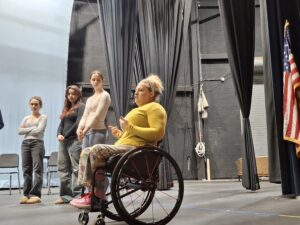
Tony Award winner Ali Stroker visited Briarcliff High School theatre students, along with her husband, acting coach and 2003 alum David Perlow, to facilitate a workshop.
After doing some warmup games, Stroker and Perlow spoke at length about their experience in showbiz, in particularly in the theater world, giving students practical tips and inspiration.
Perlow shared that after being an actor for 20 years, he eventually moved on to coaching actors and discussed how harnessing nerves before getting on stage can help you perform.
“When you’re doing something that you really care about and that’s important to you, your insides are going to be active, so if you can just take a deep breath and send oxygen to that place of stress, when you exhale, you blow the nerves out into the world and kind of convert them into excitement,” he said.
He also discussed certain acting techniques, like Lee Strasberg and Stanislavski.
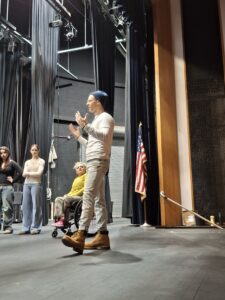
“The character is a perception of the audience, and the actor is responsible for weaving together a collection of moments that are built on what a character is,” he said. “You’re showing the audience a journey from A to B for your character in a way that the writer intended.”
Stroker, who shared that she has been in a wheelchair as a result of being in a car accident at age two, said that she knew she wanted to perform since she was eight years old.
“I was really fortunate to be raised by my parents who said to me, ‘you can do anything, but you’re going do it in your way,’ and as the first actor on Broadway who was in a wheelchair, my experience of being an actor with a disability has been amazing.”
She also discussed her early struggles in finding roles upon graduating from college.
“I had an agent, but I couldn’t get an audition, so I started writing my own show,” she said. “I have a one-woman show that I still perform to this day.”
Getting rejected through auditions can be daunting, but Perlow had an uplifting message for the students.
“As someone who has not been an actor for a long time, but who is a leader and an organizer, I can tell you that very rarely is someone not well-intentioned. Generally, people are really trying to do the best they can,” he said.
Stroker shared examples of how she has been turning her limitations into opportunities.
“I cannot dance the way Broadway actors dance on stage, but I have found opportunities to move and use my physical vocabulary to dance and to create moments on stage that have never been done before,” she said. “Also, in a wheelchair, you move more quickly and more smoothly across the stage.
“When we put disability on stage, we invite people into that world, and this is really powerful,” she added. “Whether people are uncomfortable or inspired or motivated, that’s up to them, but we can bring that truth, and that’s what’s been exciting for me in my career.”
Perlow discussed his experience as a freshman at the high school.
“The theater was built in 1998, when I was in eighth grade, and having this beautiful space, it just made us students feel like superstars,” he said. “I received nothing but encouragement from Ms. (Jamie) Mandel and from Ms. Kathleen Warren, who used to direct the musicals, and no one had done that before. I have been on Broadway five or six times, and I don’t think that would have been the case otherwise. The theatre at the school was the only place outside of my house that I felt at home, and that’s just the product of the culture that was created by the teachers.”
Perlow was happy to see this tradition is still taking place today.
“This culture continues at the high school. You see these kids, and they are so bright and they just love it! It is still a place for kids who like the theater and just want to express themselves,” he said.