


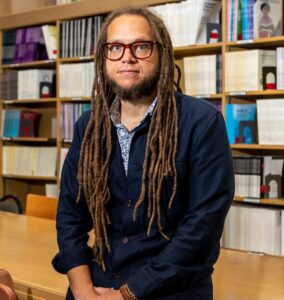
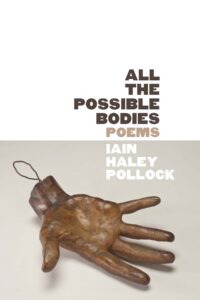
Ossining poet Iain Haley Pollock explores identity, justice and what it means to live truthfully in All the Possible Bodies, his third poetry collection released by Alice James Books on Sept. 16. The collection examines the myths we spin about self, family and nation, grounding those larger questions in imagery drawn from real life. Through musical and reflective language, Pollock looks closely at the ways we value one another, the contradictions we live with, and the tug between our desires and our duty to the world around us.
Pollock will share his work at several local events this fall and winter, including Big Red Books in Nyack (Oct. 30), Hudson Valley Writers Center in Sleepy Hollow (Dec. 7), and Ludy Café in Irvington (Jan. 2), a fitting tour for a poet whose writing is deeply rooted in the Hudson Valley.
Pollock began writing poems as a student, but his passion grew after college, when he was living in Davis Square outside Boston. That period of growth led him to the MFA program at Syracuse University, where he found community and direction as a writer. His first book, Spit Back a Boy (2012), examined childhood and race, while his second, Ghost, Like a Place (2018), reflected his evolving identity as a father and his move from Philadelphia to the Hudson Valley. His newest collection was born from the turmoil of 2020, when the pandemic and nationwide protests following George Floyd’s murder brought issues of justice and identity into sharper focus.
“Each book has taken me about seven years to write,” Pollock says. “That pace allows me to balance family, teaching and writing.” Much of All the Possible Bodies came together during scattered moments, drafted late at night or between life’s many obligations. He describes the process as one of catching inspiration whenever it arrives, then returning with discipline to revise. “Revision is where the poems are really made,” he explains. “That’s when I reshuffle the day to make space for the work.”
 When faced with creative challenges, Pollock looks for new ways to see the world. “I try to break my routine and get outside,” he says. “Driving, hiking, looking at art, or just sitting by the river helps me see things differently.” Reading, too, plays a vital role in keeping his creativity alive. “Literature is a conversation,” he says. “Reading gives me a partner to talk to.”
Pollock and his family settled in Ossining several years ago, drawn by its diversity, walkability and access to both the Hudson River and the natural world. “Ossining is all over this book,” he says with a smile. “Nelson Park, the Old Croton Aqueduct Trail, Ossining High School, the Sing Sing Kill Walkway, the town and its people are part of these poems.” He often writes about his surroundings and neighbors, drawing inspiration from their persistence and humanity. “In our complicated American moment,” he says, “they go on struggling to be human.”
When he’s not writing, Pollock can be found around town enjoying Ossining’s creative energy. He praises Hudson Valley Books for Humanity and Bethany Arts Community for their cultural impact and says he revised much of All the Possible Bodies at First Village Coffee, his go-to spot for writing. For a meal, he loves Docas, Melike and Cravin Jamaican, and for a drink, Sing Sing Kill Brewery is a favorite local gathering place. In summer, he enjoys the simple joy of evenings at Engel Park, watching families gather by the river. When he needs space to think, he turns to nature, climbing Turkey Mountain with his kids or wandering through Teatown and the Rockefeller Preserve. “Those are the places where I reset,” he says. “They help me reconnect to the larger world and the quiet that writing comes from.”
Pollock’s poetry continues to grow alongside his life, each book reflecting the changes in his world and the world around him. Whether writing about race, fatherhood, or the shared landscapes of the Hudson Valley, his work captures the beauty and complexity of what it means to be human. In All the Possible Bodies, that honesty feels especially clear, a reminder that poetry can still help us see ourselves, and each other, with deeper understanding.