



Lyndhurst Mansion in Tarrytown has unveiled the Paula Hayes Garden, a permanent land-art installation by sculptor and land artist Paula Hayes, enveloping a Hudson River overlook terrace, which explores issues of sustainability and climate change.
Completed in May and now on view to visitors, the extensive garden of native plants and grasses arranged as a loose mandala is set with five of Hayes’ signature garden sculptures and is the first publicly accessible landscape by Hayes, whose commissions have until now been private.
The garden surrounds the recently restored terrace, a raised platform providing panoramic views of the river originally constructed in 1905 by philanthropist Helen Gould, daughter of railroad baron Jay Gould. An avid naturalist, Helen Gould built the overlook as a landscape feature, perched on the branches of an espaliered white birch tree, to be used by her nieces and adopted children and serving as a breezy outdoor summer office prior to the introduction of air conditioning.
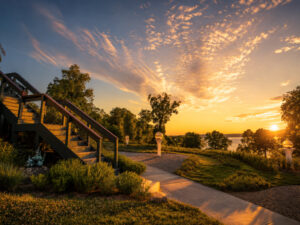
The overlook vanished from the landscape in 1956, and the weeping European white birch around which it was originally built could not be replanted due to climate change. Reconstructed from historic photographs and archaeological evidence, the restored overlook became the occasion for Lyndhurst to invite Hayes to reimagine the surrounding landscape. The three-year commission places her in direct dialogue with the picturesque tradition of the existing historic landscape, much of it designed in the 1860s as a private Central Park.
Hayes’s work proposes a “new picturesque” for the 21st century, rooted in ecology rather than ornament. Installed in two phases, beginning with a pollinator garden of native plantings in 2025 and completed with the landscape and sculpture program, the Paula Hayes Garden is composed entirely of native, pollinator-friendly species, many of them selected from early 20th garden supply catalogues in Lyndhurst’s own collection.
Flowing bands of grasses move in the breeze and change with the seasons, creating vital habitat for birds, bees, and small animals while serving as an open-air gallery for five original sculptures by the artist. A mandala of native plants reads as a meadow from the footpath; seen from above from the Overlook terrace itself, its colored circles come into full view.
The installation weaves through the estate’s existing pathways between the mansion and the historic bowling alley, choreographing the visitor’s experience in a picturesque manner typical of 19th-century landscape design. Traditional landscape elements leading into and out of the Overlook Garden were also restored at the time.
A large weeping beech and a hedge of mock orange screen the overlook before a full panoramic reveal; a bench beneath an existing tree faces a contemplative birdbath by the artist, the same model displayed in the Museum of Modern Art’s Sculpture Garden, here realized in a custom purple colorway that echoes the color of mature grasses; a grove of flowering shrubs shelters a whimsical garden gnome in bronze, its pointed caps recalling traditional Victorian garden figures and echoing the spires of the imposing Gothic Revival mansion looming above it.
Three of Hayes’s signature Gazing Globes — transparent polycarbonate spheres encasing upcycled radio components, vintage technology, and a “fairy dust” of pulverized CDs, illuminated from within — reinterpret the gazing balls of Victorian gardens while reflecting on technology’s place in the natural world.
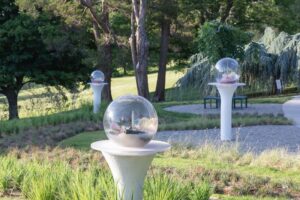
“I have always been interested in the interplay of the sculptural quality of plants with sculpture and how such forms as the mandala serve as vessels for our experience and understanding,” Hayes stated in a press release announcing the garden. “The purple color of the manmade cast birdbath in harmony with the same color of little bluestem grasses and coneflowers reflects the harmony of manmade and natural elements that I seek to achieve in my works.”
Howard Zar, Lyndhurst’s executive director, called the garden “simply magical.”
“The Paula Hayes Garden allows us to place an exhibition of contemporary art outdoors in the landscape where it can be experienced by those who might not be interested in visiting a traditional white cube gallery space,” he stated. “While Hayes’ pieces work as contemporary art of the highest caliber, they are also extremely accessible, reaching the broadest array of visitors. As a piece of public art, we wanted something that appealed both to the cognoscenti and to those who don’t consider themselves art aficionados.”
The grounds are open to visitors seven days a week, 9:30 a.m. to 5 p.m. Visitors arriving by vehicle may purchase a grounds pass and traverse the property at their own pace. Visitors may also access the property for free from the Old Croton Aqueduct and Westchester RiverWalk trails, which both traverse the property.
Also on view in Lyndhurst mansion is an exhibition of five paintings by contemporary artist Marc Dennis. Dennis’s work is heavily influenced by the practices of the 19th-century academy, and his paintings are placed in conversation throughout Lyndhurst mansion with the types of paintings that influenced his contemporary style. His five paintings can be seen in the Lyndhurst entry hall, parlor, stair hall, and grand picture gallery.
Lyndhurst mansion can only be visited by guided tour. Tickets can be purchased in advance at lyndhurst.org.