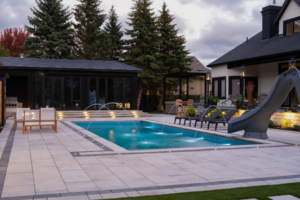
Every winter, backyard pools in colder regions can develop hairline cracks as the ground around them freezes and thaws. Homeowners who watch a pool shell shift after only a few seasons often start looking for a sturdier build before they dig again.
Insulated concrete form construction, known as ICF, has become one of the more discussed answers to that problem. Companies that build ICF pools in Toronto report growing interest from homeowners who want a pool that holds its shape through frost heave and stays warmer later into the season.
This guide walks through how the construction method works, what a project typically costs, and where it makes the most sense for a backyard renovation.
Key Takeaways
- ICF pools stack foam insulated forms and fill them with reinforced concrete, combining structure and insulation in one step.
- The built in foam can lower a pool’s ongoing heating costs by roughly 60% compared with an uninsulated concrete shell.
- The reinforced walls resist the ground movement that clay heavy soil produces during seasonal freeze thaw cycles.
- A fully custom project in the GTA typically starts around $190,000 and can climb past $340,000.
- Every backyard pool in the city needs a compliant enclosure and permit before the water goes in.
What Makes an ICF Pool Different From a Standard Concrete Pool
Most concrete pools are built with temporary forms. Crews pour the concrete, let it cure, then strip the forms away and add insulation and finishing as separate later steps.
An ICF pool skips that extra step. Hollow blocks made of expanded polystyrene foam are stacked to form the pool walls, reinforcing steel is threaded through the cavity, then concrete is pumped in to fill the void. The foam forms stay in place permanently, becoming a built in layer of insulation on both sides of the finished concrete.
Compared with shotcrete or gunite, where wet concrete is sprayed onto a rebar frame by a specialized crew, the stack and pour sequence used here needs less specialized equipment on site. That can translate into fewer scheduling delays once excavation is finished and the forms are ready to go.
| Pro Tip: Ask any contractor how many ICF pools they have completed before signing a contract. The stacking and pouring sequence takes different skills than a standard concrete pour, and hands on experience matters more here than with most other pool types. |
Because the foam blocks are lightweight, crews can carry them in by hand rather than craning a shell over a house. That makes this method a practical option for backyards with narrow side yard access or tight downtown lots, where heavy equipment often cannot reach the dig site at all.
The general build sequence looks like this:
- Site assessment and permits, including a zoning review and 3D design walkthrough.
- Excavation, followed by stacking of the insulated forms with rebar placed before the pour.
- The concrete pours itself, which forms the insulated shell, followed by a curing period.
- Interior finishing, plumbing, filtration, and the surrounding deck or hardscape work.
[VIDEO: “Pool construction ICF step by step” —
https://www.youtube.com/watch?v=twIFhsndx8g]
This short walkthrough shows the stacking, bracing, and pour sequence described above from an actual build.
Why Insulation Matters in a Cold Climate
A pool loses most of its warmth through the ground rather than the surface, since surrounding soil pulls heat away faster than open air does. That is one reason an uninsulated shell often needs more frequent, more expensive heating through a typical Ontario swim season.
| Key Stat: Up to 80% of a pool’s heat can escape through its floor and side walls when there is no continuous insulation layer in place. |
Estimated heating energy use for a standard poured concrete pool versus an ICF pool of similar size.
Continuous foam insulation around an ICF shell interrupts that escape route. Several manufacturers report that pool owners see meaningful drops in monthly heating bills once the ground contact loss is addressed, and the comfortable swim season often stretches further into spring and fall as a result.
A pool built to handle freeze thaw movement today is a pool that still looks the same in twenty years.
The same foam layer that traps heat also helps the shell handle freeze thaw stress. Clay soil common across the Greater Toronto Area expands as it freezes and contracts as it thaws, and that repeated movement is what eventually cracks an unprotected concrete shell. For more detail on how continuous wall insulation performs under Canadian conditions, Natural Resources Canada publishes homeowner guidance on insulating walls.
Permits and Bylaws Before You Dig
Every swimming pool in Toronto needs to clear a permit process before it can hold water legally. The first step is usually a Zoning Certificate confirming the pool’s location respects setback and lot coverage rules.
Once zoning is approved, homeowners apply for a Pool Fence Enclosure Permit through Municipal Licensing and Standards. Toronto Municipal Code Chapter 447 sets the enclosure rules, covering self closing gates, self latching hardware, and minimum fence heights. Full details are published on the City of Toronto’s pool enclosure webpage.
| Warning: Filling a new pool with water before the enclosure passes inspection is a common and costly mistake. The city requires a completed, compliant fence before any water goes in, and skipping that step can mean draining the pool to fix the fencing afterward. |
Properties near a ravine, the Humber River, or the Don Valley may also need approval from the Toronto and Region Conservation Authority. A contractor familiar with these local approvals can usually build this step into the design timeline rather than treating it as a separate delay later on.
What an ICF Pool Costs
Cost is usually the first question homeowners ask, and this construction method sits at the higher end of the pool market because of the materials and specialized labor involved.
Typical installed cost ranges by pool construction method in the Toronto and GTA market.
| Pool Type | Typical Installed Cost (GTA) | Best For |
| Vinyl liner | $40,000 to $70,000 | Budget conscious builds, flexible shapes |
| Fiberglass | $55,000 to $95,000 | Fast installation, low maintenance |
| Poured concrete | $75,000 to $150,000 | Fully custom shapes and finishes |
| ICF (insulated concrete form) | $190,000 to $340,000+ | Maximum durability and insulation in cold climates |
Across the Toronto and GTA market, a project built this way generally lands somewhere between $190,000 and $340,000, depending on size, interior finish, site conditions, and add ons such as an integrated spa. Sloping lots and premium landscaping tend to push a quote toward the top of that bracket.
That figure usually covers design work, permitting, excavation, the insulated shell itself, interior finishing, and basic surrounding hardscape. Extras such as a pool house, an outdoor kitchen, or an expanded lighting package will add to the total, so it helps to ask a contractor exactly what a quote includes before comparing numbers between companies.
Design Features You Can Add
This construction method does not limit design the way some prefabricated shells do. Because the insulating blocks can be cut and shaped on site, a pool built this way can take on nearly any layout a homeowner wants.
- Integrated spas and sunken tanning ledges
- Decorative stone coping and custom steps
- LED lighting and modern water finishes
- Waterfalls, bubblers, and other water features
- Seamless landscaping that blends the pool into the rest of the yard
When a pool build is part of a bigger backyard overhaul, it helps to plan the surrounding space at the same time instead of treating it as an afterthought later. This guide to improving your outdoor space covers seating, shade, and landscaping choices that pair well with a new pool.
One HomeStars reviewer who hired Action Home Services for an inground build described the crew as punctual and professional, noting that work started early each morning and continued until the coping and finishing details were done. That kind of steady, in house process is fairly typical of how these projects get managed from permit to final walkthrough.
Frequently Asked Questions
How long does an insulated concrete form pool take to build?
Timelines vary with project size, permit approval speed, and weather, though homeowners should generally expect the process to take somewhat longer than a typical poured shell takes, given the added stacking and curing steps involved.
Are these pools more expensive than fiberglass or vinyl options?
Yes, generally. This method costs more upfront than vinyl or fiberglass because of the reinforced concrete and insulated forms, though the added materials and labor also bring extra durability and thermal performance over the pool’s lifespan.
Can the interior finish be resurfaced or repaired later?
Yes. The interior surface, whether plaster or a vinyl liner, can be repaired or replaced without touching the structural shell underneath, since the insulated walls sit behind that finish layer.
Do homeowners need a permit before construction starts?
Yes. A Zoning Certificate and the required enclosure permit both need approval before construction begins, and the finished pool cannot legally hold water until an inspector signs off on the completed fence.
How much can the insulation realistically save on heating?
Manufacturer estimates put the savings at roughly 60% versus a shell with no insulation, though actual results depend on pool size, heater type, and how often the family uses the pool through the season.
This construction method will not suit every backyard or every budget, but it solves a specific problem well. It gives homeowners a pool built to survive genuine freeze thaw stress without cracking or bleeding heat every single season.
For anyone planning a pool meant to last for decades rather than a single decade, the higher upfront investment often shows up later as fewer repairs and a longer, more comfortable swim season each year. Getting a detailed, itemized quote from an experienced contractor remains the clearest way to see whether those numbers make sense for a specific property.
References
City of Toronto, Swimming Pool Enclosures and Fence Bylaw Information, 2026, https://www.toronto.ca/home/311-toronto-at-your-service/find-service-information/article/?kb=kA06g000001cvVtCAI
Natural Resources Canada, Keeping the Heat In, Section 7: Insulating Walls, https://natural-resources.canada.ca/energy-efficiency/home-energy-efficiency/keeping-heat-section-7-insulating-walls-insulating-renovating-building-additions
Fox Blocks, ICF Pools: Building Swimming Pools with Insulated Concrete Forms, 2023, https://www.foxblocks.com/blog/icf-pools
Action Home Services, ICF Pool Installation Toronto and GTA, 2026, https://actionhomeservices.ca/icf-pools/
HomeStars, Action Home Services Customer Review, https://homestars.com/companies/2888655-action-home-services/reviews/857389
Fact Check: All statistics and data points in this article were verified against original sources as of August 21, 2026. Sources are listed in the References section.