

An innovative program is giving children the opportunity to get a firsthand look at the fascinating world of bees and pollinators, while helping them to start healing from trauma at the same time.
Now in its second year, Flower to Hive is a therapeutic and educational beekeeping program run by Abbott House, an Irvington social service agency seeking to help people with complex needs achieve promising futures. Abbott House parters on this program with Lyndhurst, the historic estate overlooking the Hudson River in Tarrytown, where the children partake in the hands-on beekeeping program.
Justine Christakos, president and CEO of Abbott House, said, “Many of the children at Abbott House have experienced significant trauma. Through beekeeping, they witness firsthand how a hive grows, adapts, and overcomes extraordinary challenges. That process sparks curiosity while teaching powerful lessons about their own resilience and connection to the natural world.”
Christakos pointed out that children gain a sense of accomplishment and connection, which helps restore feelings of safety, belonging, and purpose. The goal is that through these experiences, the children will begin to heal as they find peace in nature and joy in discovery.
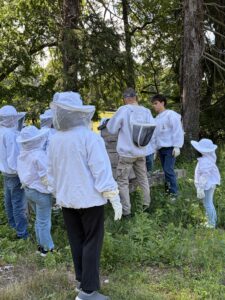
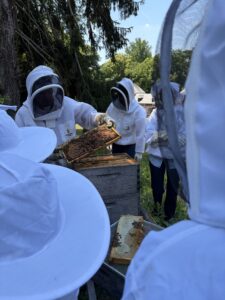
With guidance from beekeeper Dennis John (DJ) Haverkamp of Bedford Bee Honeybee Service, children don protective suits, observe the hive, extract honey from the honeycomb, and even craft beeswax candles and make honey. They see hands on what a vital role bees play in our ecosystem. According to Christakos, there are over 40,000 bees and two hives, with a third hive in the planning stages. The honeybees support pollination at Lyndhurst’s gardens and benefit the surrounding community, foraging up to two miles from their hive.
Kristina Papa, Abbott House’s chief advancement officer, said that groups of approximately 20 kids (ranging in age from eight to 17) and their teachers visit Lyndhurst each month, beginning in May and continuing through October. “They continue their nature-based learning in the Abbott House Children’s Peace Garden, which features a rainbow garden and a bee sanctuary full of pollinator plants and flowers made possible by the organization Something Good in the World,” she said.
“During their most recent June visit to Lyndhurst, kids witnessed baby bees hatching and helped administer a mite treatment to keep the hive healthy. They also got to taste honey off the comb and ended the day with honey-infused ice cream cones under a nearby shady apple tree,” said Papa.
The installation of honeybee hives, a native pollinator garden, and immersive beekeeping workshops are all made possible thanks to the vision and generosity of Emily Rockefeller, a supporter of both Abbott House and Lyndhurst. Growing up, Rockefeller’s father kept bees as a hobby, helping her to understand the critical role bees play in sustaining our environment. Building on that early influence, she approached Abbott House with the idea of establishing honeybee hives to introduce children to the art of beekeeping, while also supporting pollinator health and environmental stewardship.
Papa explained that Flower to Hive is more than an educational program, “It’s a healing experience that teaches cooperation, trust, and interdependence by observing how bees work together.” The program also builds patience, responsibility, and confidence through hands-on activities like planting and caring for the environment.
“At Abbott House we believe deeply in the healing power of art, music, gardening and other holistic activities that build confidence and support the emotional well-being of everyone in our care. Beekeeping became a new and exciting extension of that vision,” said Papa.
The honey produced through the Flower to Hive is currently available at Lyndhurst’s gift shop. Produced in collaboration by the children of Abbott House and the Bedford Bee Honeybee Service, it is sold under the label The Gilded Honey, reflecting the partnership between Lyndhurst and Abbott House. The current honey was harvested with the help of Abbott House children last October.
PHOTO: Bee Photo1 Photo Abbott House
CAPTION: There are over 40,000 bees and two hives, with a third hive in the planning stages. Photo Abbott House
PHOTO: Bee Photo2 Photo Abbott House
CAPTION: Children don protective suits, observe the hive, extract honey from the honeycomb, and even craft beeswax candles and make honey. Photo Abbott House