


In the last few months, dozens of research lab beagles have been taking their first tentative steps on grass in Westchester after being freed from Ridglan Farms, a Wisconsin breeder and testing lab facing felony animal cruelty charges.
These beagles—the breed chosen because they are cheerful and easy to handle—had spent their entire lives in small, wire-bottom cages, stacked in huge farm sheds. Neighbors didn’t even know what Ridglan was until a massive, decade-long effort to expose and stop its animal testing.
The dogs are only getting new lives because of a politically diverse team, ranging from the president’s daughter-in-law Lara Trump to Savethedogs.io, an open rescue group that twice broke into the farm and came out with dogs and scary video of their conditions. The campaign culminated in April when 1,000 dog lovers (including me) tried to get dogs out.
We were a kind of dog rescue Cajun Navy, regular people who had driven across the country in minivans and pickups hoping to rescue 2,000 beagles that the government couldn’t or wouldn’t. The lab had agreed to shut down, but the beagles were trapped in legal limbo, as well as the physical fortress Ridglan had constructed.
I was there because my husband David and I adopted two beagles, Huckleberry and Moxie, from a Corapeake, N.C. lab that shut down in 2010. Only in 2024 did I learn they were from Ridglan, thanks to Michael Taylor, a data analyst who has former research lab beagles, cracked the code on their cryptic ear tattoos.
Finding they were from Ridglan was particularly upsetting because former staff had testified that non-veterinarians routinely removed beagles’ cherry eye (third eyelid) and vocal chords without anesthesia. Moxie, who was 17 at the time of the April action, had never barked. Could they have done that to her?
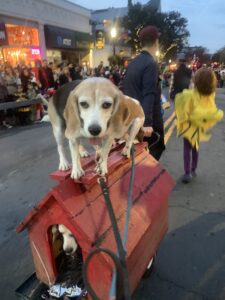
When we first got Moxie, she was so scared she would lay flat on the sidewalk. But both dogs quickly blossomed. For years, Moxie would showboat her way through the Tarrytown Halloween Parade riding on top of a Snoopy dog house, lapping up the praise and treats. Huck, more mellow, rode inside. I had to go to Ridglan. My dogs are family, so their relatives inside were, too.
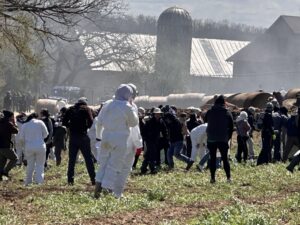
The day itself was a disaster. The local sheriff and private security arrested many, knocked out teeth, and covered the area in tear gas and pepper spray. No dogs got out. I was way back, but still caught enough tear gas to start coughing up blood the next day. When I got home to Sleepy Hollow, I was diagnosed with pneumonia.
Photos of the rescue attempt, which looked like a battle between men in tactical gear and old ladies, went viral, shifting public opinion Lara Trump spoke out for the beagles, and eventually, her group—Big Dog Ranch Rescue—paid Ridglan to get the beagles out for an undisclosed sum. Thousands more volunteers jumped in to transport the 1,960 dogs who were freed to 18 states. Everyone wanted to be part of the story; even the USDA and Robert Kennedy, Jr. praised the release. Getting dogs out of research labs is one of the few things Americans agree on.
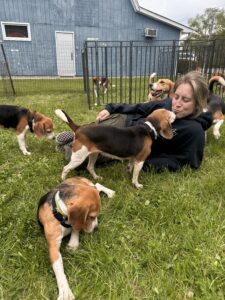
Locally, S.N.A.R.R. in Brewster, SPCA in Briarcliff Manor, and BeFreegle in Wappinger Falls all got Ridglan beagles. BeFreegle specializes in finding homes for research lab beagles and has helped populate Westchester with beagles.
Local beagle lovers from Tarrytown to Stamford scrambled to sign up to foster. No need. Even though these dogs would need lots of patience (and housetraining), people loved their story. They all got adopted quickly. I said yes to fostering six times before I got a beagle. And he got adopted in a day.
Our community has a checkered history when it comes to dog testing. In the 1920s, Cornell University created a dog farm in Peekskill that dabbled in eugenics and compared dog breeds to human races. Columbia University planned a rival dog lab at what is now the Nevis Laboratories in Irvington, but it fell apart in World War II, according to Lab Dog, by Brad Bolman. Today, these dog research facilities are hidden in unmarked warehouses.
The coalition that freed the Ridglan beagles is now looking to do the same with the country’s biggest breeder, Marshall BioResources, which is located in New York, outside Rochester. It has an astounding 14,565 beagles, according to its May USDA report.
If the fall campaign to march to Marshall from Albany goes well, there may be even more families in Westchester with a former research lab beagle.
All photos provided by Carol Vinzant.