


The developer of the proposed Renaissance Briarcliff estimated his project to build 110 luxury townhouses and five single-family homes on the former Pace campus could start in mid-to-late 2027 subject to final approvals.
Leonard Glickman’s Rose Enterprises Group won preliminary approval for zoning that would permit the development but still has hurdles to clear before transformation of the long-vacant 37-acre parcel on Elm Road can begin.
Next steps include seeking approval from the Westchester County Department of Health to create a Planned Unit Development zone that ultimately must be passed by the Village of Briarcliff Manor’s Board of Trustees.
“In about six-to-seven or eight months we’ll get final PUD approval,” Glickman said in an interview in late June. Subject to final approvals, he estimated work at Renaissance Briarcliff could start in mid-to-late 2027.
The property was the home of Mrs. Dow’s School for Girls (founded in 1903) renamed Briarcliff College and later became Pace University. Since Pace sold the parcel in 2017, it has remained vacant and fallen into a state of disrepair, according to the developer and the village.
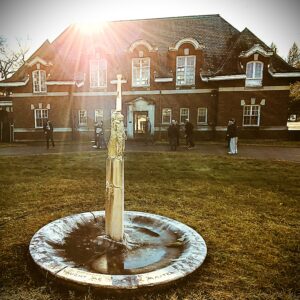
“Me too thy nobleness had taught
To master my despair;
The fountains of my hidden life
Are through thy friendship fair.”
Photo: Robert Brum
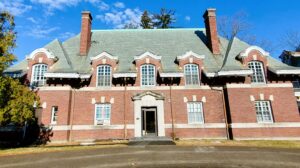
The state Historic Preservation Office is reviewing the proposed demolition of Dow Hall, the 120-year-old former school building on the property, which is eligible for listing in the State and National Registers. It was unclear how such a designation could affect the project.
The village’s Advisory Committee for History & Archives is reviewing potentially salvageable items including the fountain outside Dow Hall, signage, paintings, wall sconces and lanterns.
A scale model of the building and a plaque paying homage to its history would be placed somewhere on the property, Glickman said.
Demolishing Dow Hall and nine other buildings on the campus would cost “several million dollars,” Glickman said.
“At the end of the day, it’ll take a couple more months, but we’re confident we’ll come to a consensus of the demolition of the building,” he said. “With the exception of Dow, they’re mid-century modern, so to demolish those is not difficult.”
Glickman pledged the demolition would not create “the kind of disruption that will be offensive or oppressive. There are moments when there will be some activity. It’s well organized, it’s well executed. Staging areas are created to minimize impact for adjoining neighbors.”
The developer said Renaissance Briarcliff would be “a great asset for the village. I think it provides another product type that is sorely needed in the village, something between a rental and the purchase of a large single-family home. And reasonable growth is good for the village. These are economic drivers. People don’t realize that multi-family today is an economic driver.”
In the midst of a lengthy process layered with public hearings and procedural bumps, Glickman called Briarcliff “a great community to invest in.”
“What I liked about Briarcliff is that there is a concerned citizenry, an involved citizenry,” he said. “You have a community which is invested in itself. We like that, we like to be involved with communities which care about themselves.”
Rose Enterprises is in contract to purchase the campus from Yeshivath Viznitz Dkhal Torath Chaim, contingent on receiving final approvals. The framework for the sale followed an agreement between the village and yeshiva, which had filed a federal religious discrimination lawsuit.
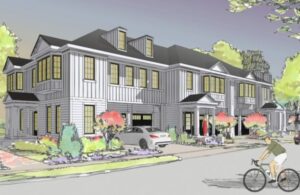
Renaissance Briarcliff at a Glance:
- 110 two- and three-bedroom townhouses would be taxed at full value rather than at the 75 percent rate that other condominiums in the village pay.
- The five single-family homes fronting Tuttle Road would not be built by Rose Enterprises.
- 10 acres of wooded open space plus an outdoor pool and clubhouse for use by residents and their guests.
- 66,000 square feet of publicly accessible open space off Elm Road with walking trails and benches, plus a publicly accessible walking trail around the entire site.
- Rose Enterprises would pay an estimated $1.3 million recreation fee to the village depending on the number of units approved.
- The project is estimated to generate $5 million annually in taxes, $1 million of which would go to the village and $3.3 million to local schools.