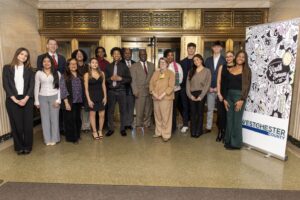


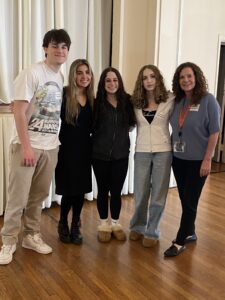
Four Briarcliff High School students recently attended a conference that provided them with tools to help prevent peer conflict.
The Westchester Youth Leadership Conference was held in White Plains and was sponsored by the Westchester Coalition for Drug and Alcohol Free Youth, in collaboration with the Office of Drug Abuse Prevention & STOP-DWI and Student Assistance Services.
More than 200 students from 33 Westchester high schools attended the conference, including Briarcliff senior Alexandra Orr, junior Peter Sara and sophomores Zoe Amsterdam and Gabriella Vignola, who are all members of the school’s Students Against Destructive Decisions (SADD) Club as well as the Westchester County Youth Leadership Task Force.
According to Briarcliff Student Assistance Counselor and SADD Club Adviser Meredith Ohmes, the purpose of the conference was to help students understand their role in an increasingly complex world while promoting wellness, positivity and peer leadership.
“Students could explore the opportunity to be role models and learn how they can become positive leaders who model nonviolent behavior and influence their peers toward safer, healthier school environments,” Ohmes said. “They also had the opportunity to interact with students from other schools throughout the county and exchange ideas to help inform their peers about the importance of making a difference in their world.”
The conference began with Westchester County Executive Ken Jenkins, who welcomed the students. He was followed by Ken Nwadike Jr. of the “Free Hugs Project” (who visited Briarcliff Middle and High School two years ago) and Kym Laube of Human Understanding Growth Services, Inc.
“Mr. Nwadike showed us what radical empathy can look like in action,” Zoe said. “In a world that often feels divided, Ken has stepped into moments of real tension, including protests and civil unrest, with nothing more than a message of peace and a willingness to connect. His work demonstrates how powerful human connection can be in de-escalating conflict and his message to young leaders was clear: you do not need a megaphone to make an impact. Sometimes leadership begins with the courage to listen.”
Laube and her team led an interactive workshop.
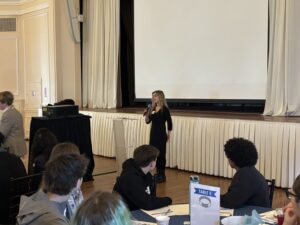
“The workshop was energizing,” Zoe said. “Drawing from her own journey to being a national prevention leader, Ms. Laube challenged us to think about the influence we have every day. Her message was simple and powerful: leadership means taking responsibility for the space around you and choosing to make it better.”
The takeaway from these powerful leaders, Zoe said, was that leadership is ultimately about the choices we help others make.
“One showed us how human connection can break down barriers in a moment, while the other provided us with the tools to lead and strengthen our environments: schools, work and communities,” she said.
Zoe, who served as the host at the conference and introduced the speakers, was commended by Patricia McCarthy Tomassi, Head of the Office of Drug Abuse Prevention and STOP-DWI Westchester Coalition for Drug and Alcohol Free Youth.
“Zoe was poised, well-spoken, personable and represented her school with dignity and honor” she said.
Peter is new to the SADD Club this year, and this was his first time attending the conference.
“It was very valuable,” he said. “We did thought-provoking exercises that helped us reflect on determining if we wanted to be bystanders or to take action. As a junior, I feel that I should be stepping up to be a role model for the younger students in my track team, for example. I would like to be an active participant, as opposed to a bystander, and to make a difference, so taking part in these exercises was worthwhile for me.”
Zoe agreed.
“I am grateful to be part of this initiative and to see so many young leaders ready to take these lessons back to their own communities,” she said. “The next generation isn’t waiting to lead; they’re already doing the work.”