



Concerns over the proposed Renaissance Briarcliff development’s density, visual impact and effects on the schools topped the list for neighbors who spoke during the project’s first public hearing.
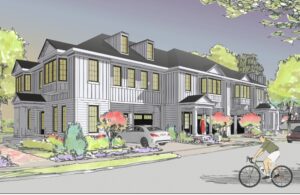
The Nov. 18 hearing before the village’s Board of Trustees was developer Leonard Glickman’s chance to pitch his plan for 110 luxury townhouses and five single-family homes at the former Pace campus on Elm Road.
The two- and three-bedroom units targeting a mix of empty-nesters and younger couples would be taxed at full value rather than at the 75 percent rate that condominiums in the village pay. The single-family homes fronting Tuttle Road would be custom-built.
Glickman’s Rose Enterprises is in contract to purchase the 37-acre campus from Yeshivath Viznitz Dkhal Torath Chaim, contingent upon receiving approvals needed to move forward with the estimated 18-24-month project.
Glickman told the crowd in the village community room and several dozen others on Zoom that he plans to engage the community as the process goes forward.
“This is something we take great care with in terms of creating a concept plan,” he said. “It’s not just something we throw up. We’re not interested in maximizing for the sake of maximization. We want to do something that will create an environment that will stand the test of time.”
He added: “We are a profit-making organization, there’s no doubt about that, but it’s not only about profits, it’s about pride and generations.”
Roughly a half-dozen neighbors of the Elm Road campus spoke at the hearing
Keith Austin commented that the 110 units appeared to be too close together and was concerned about the visual impact of the 35-foot height permitted under the site’s yet-to-be-approved Planned Unit Development zoning.
Michael Bryne said estimates of the number of new students generated by the project —which went from 82 to 22 after the developer dropped four-bedroom units from the plan — “defy logic.”
Byrne said student enrollment at Todd Elementary School had risen by 9 percent over five years. “This impact from 235 Elm will put more of a burden on the schools,” he said. “Right now, the school system is not underutilized. In my opinion it is at capacity or over capacity.”
He raised doubts about other estimates on the project’s website, adding: “I think when we really look at this, we need to pump the brakes and slow down and see is the data there, does it make sense, is it logical?”
James Bombassi asked the board to consider less density for the project and wants to preserve Tuttle Road’s rural character. “It’s bucolic, it’s tranquil and we’d like to keep it that way,” he said.
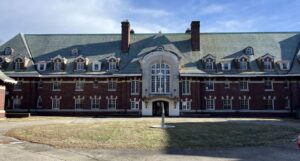
Steve Reiss called the property’s current state “dilapidated, it’s really an eyesore,” adding that “any new type of construction would be an improvement on what it looks like currently.”
But he supported increasing the setbacks “and potentially lowering the density a little bit to make it a little more palatable.”
Doubts were raised about Glickman’s contention that townhouses with first-floor master bedrooms would not appeal to families with children.
In response, Glickman touted the project’s economic benefit, claiming each townhouse would generate $5,000 to $6,000 in local spending, and said it addressed Briarcliff’s older demographic by providing opportunities to downsize.
He vowed to use landscaping to answer concerns over the visual impact of the housing. “It will not be a visual blight; you will not see it from the road,” he said.
Glickman stood by estimates of the project’s impact on schools and pointed to an analysis of Westchester development. He said townhouses generated fewer school children than single-family homes, and the number of children per family was trending downward.
“This is an evolutionary process,” he said. “When we have new facts and a new understanding, we adjust.”
In terms of the project’s density, he said: “I ask you; will 105 units make a difference instead of 110 units? Is that really going to make a difference? I don’t know that to be true.” He added that there was “a tremendous amount of risk inherent in a project like this … there’s no guarantee of profit.”
The meeting also touched on the future of Dow Hall, which has stood on the campus since 1903 and has been targeted for demolition (along with nine other vacant buildings) by Rose Enterprises despite some who want it preserved.
“Dow Hall has decayed, it is decrepit, it is unsightly and maybe more than anything, it is physically not conducive to adaptive reuse for residential purposes,” David Steinmetz, a lawyer representing the developer, said at the start of the hearing.
Steinmetz said the developer is consulting with the state Historic Preservation Office and would potentially save some elements of the building for use in the project’s clubhouse or donate them to the village.
The public hearing is to continue on Dec. 2, including the developer’s presentation and discussion on the Planned Unit Development zoning that requires approval for the project to move forward.
Renaissance Briarcliff Manor would include 10 acres of open space, walking trails and a pool. The development would put the parcel back on the tax rolls and generate an estimated $5 million annually, $1 million of which would go to the village and $3.3 million to local schools.
Rose Enterprises would pay an estimated $1.3 million recreation fee to the village depending on the number of units approved.
The project’s approval is in the hands of the Board of Trustees, with input from the Planning and Architectural Review boards. Village officials could potentially ask Glickman to adjust the project’s size based on its own studies and residents’ input.
Rose was selected as the seller’s preferred buyer after an agreement was reached to suspend the yeshiva’s religious discrimination lawsuit against the village and to explore alternative uses of the campus, including residential uses.
It’s unclear what would happen with the agreement and litigation if Glickman’s project is not approved.