


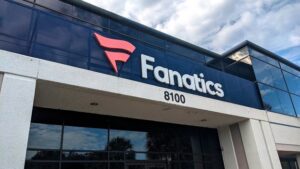
 Ask a typical American sports fan to name the most valuable private company in sports outside of the leagues themselves, and most will struggle to land on the right answer. The leagues are obvious. The biggest broadcasters are obvious. The marquee franchises in New York, Los Angeles, and Dallas are obvious. The answer almost no one offers, despite the fact that it is now embedded in nearly every transaction a fan makes, is Fanatics. The New York-headquartered company has spent the last decade quietly stitching together one of the most ambitious commerce empires in modern American business, and 2026 is the year that empire is becoming impossible to ignore.
Fanatics finished 2025 with approximately $13 billion in revenue, according to figures CEO Michael Rubin cited in January, up from $8.1 billion a year earlier. The company carries a private market valuation of roughly $31 billion, sits at the top of every list of likely 2026 IPO candidates, and now operates across three deeply integrated business lines: apparel and merchandise, trading cards and collectibles, and a sportsbook that went live in Missouri on the first of December and is now legal in 23 states plus the District of Columbia. Rubin has publicly described Fanatics as a potential $30 billion to $50 billion annual revenue company over the next five to ten years. Coming from most founders that would sound like fantasy. Coming from him, after the year Fanatics just posted, it sounds like a forecast.
The Retail Foundation That Started It All
Fanatics traces its roots to 1995, when brothers Alan and Mitch Trager opened Football Fanatics, a small sports apparel shop near Jacksonville, Florida. The business was reasonably successful as a regional licensed merchandise retailer, but it did not become the company we now recognize until 2011, when Michael Rubin acquired it and rebuilt the model around exclusive league partnerships, integrated manufacturing, and the ability to produce championship merchandise within hours of a final whistle. That last detail matters more than it sounds. When the Kansas City Chiefs win a Super Bowl, when LeBron James changes teams, when a rookie call-up homers in his Major League debut, the jersey hits the Fanatics site before fans have finished posting on social media. That logistical edge has been the foundation of everything that followed.
Fanatics Commerce, the unit that covers apparel, hats, and licensed merchandise, generated roughly $7 billion in 2025. The company holds long-term exclusive partnerships with the NFL, MLB, NBA, NHL, MLS, and the majority of major college athletic programs, and it is increasingly the official in-stadium retail operator for individual franchises as well. The Cincinnati Bengals will open a new 11,000-square-foot Fanatics flagship store at Paycor Stadium ahead of the 2026 NFL season, the latest in a string of similar agreements that put Fanatics directly inside the gameday experience rather than competing with it from outside.
Collectibles: The Surprise Engine
The most surprising growth story inside Fanatics is the collectibles division. When Rubin announced in 2021 that Fanatics would launch a trading card business and had secured exclusive long-term deals with the NFL, NBA, and MLB, skeptics expected the pandemic-era collectibles boom to fade and the business to plateau. Instead, Fanatics Collectibles posted approximately $5 billion in 2025 revenue, roughly 38 percent of the company’s total. The combination of exclusive league rights, vertically integrated manufacturing, and the online marketplace that Fanatics built around its 2022 acquisition of Topps has given the company a structural position in trading cards that mirrors its dominance in licensed apparel. For a business that built its reputation on jerseys, the fact that collectibles now generates more than a third of total revenue is the clearest signal of how far the empire has expanded.
The Missouri Sportsbook Story
The third pillar of the empire is the one that has attracted the most attention this year. Fanatics Betting and Gaming launched in 2021, opened its first physical sportsbook at FedEx Field in 2023, acquired the U.S. operations of PointsBet in 2024, and has since become legal in 23 states plus the District of Columbia. The most recent expansion came in Missouri, where Fanatics went live for both mobile and retail sports betting on the first of December 2025 through a multi-year partnership with Boyd Gaming. Two Fanatics-branded retail sportsbooks have opened at Boyd’s Ameristar Casino Hotel Kansas City and Ameristar Casino Resort and Spa St. Charles, giving Missouri residents access to the brand both in their pockets and inside the casino floor.
The Missouri launch is significant for two reasons. First, Missouri voters only approved sports betting through Amendment 2 in November 2024, meaning the entire competitive landscape in the state is being defined in real time as the major operators stake out positions. Second, Fanatics has built its national sportsbook product around a rewards system called FanCash, which allows users to earn credits that can be spent either on more wagers or on apparel and collectibles across the broader Fanatics ecosystem. New users in Missouri can compare welcome offers and ongoing promotional structures through dedicated resources, including the Fanatics promo code page that tracks pre-registration offers, FanCash bonus structures, and No Sweat Bet eligibility as those terms evolve. The Missouri market generated $543 million in total sports wagers across the first month after launch, suggesting that initial demand has met or exceeded the early projections operators were modeling before the December opening.
What Makes the Empire Work
The strategic logic that connects apparel, collectibles, and sportsbook is the data layer that sits underneath all three. A fan who buys a jersey is the same fan who might bid on a rookie card and the same fan who might place a wager on the team that jersey belongs to. By owning the customer relationship across every category, Fanatics can cross-promote, cross-reward, and cross-convert in ways that pure-play competitors cannot replicate. FanCash earned on the sportsbook can be spent in the apparel store. That ecosystem play is what private market investors have been valuing at $31 billion, and it is what Rubin has been pointing to when he talks about long-term revenue potential in the $30 billion to $50 billion range. The model is not without risk. The betting division has been heavily loss-making during the build-out phase, and Fanatics finished 2024 with around $400 million in total debt and approximately $1 billion in cash. Profitability across that unit is the single biggest question hanging over any future IPO discussion.
Why It Matters for Hudson Valley Sports Fans
Westchester County residents may not have followed the Fanatics story closely, but they have almost certainly transacted with the company in the last twelve months. Every Yankees jersey, Knicks hoodie, Rangers hat, and Mets cap purchased through team stores, league sites, or major retail partners flows through Fanatics infrastructure. The official trading cards of the three major professional leagues now run through Fanatics Collectibles. And while New York State has not yet legalized online casino gaming, the state’s mobile sports betting market remains one of the largest in the country, with Fanatics Sportsbook competing actively alongside the established operators. The company that began as a Jacksonville jersey shop is, in 2026, one of the most influential businesses shaping how sports fans in the Hudson Valley and across the country spend their money.
Whether the empire continues expanding at this pace through the end of the decade depends on execution across all three verticals. Apparel needs to hold its dominant position against international entrants and direct-to-consumer plays from individual leagues and teams. Collectibles needs to keep growing through a category that has historically been cyclical. The betting unit needs to find a path to profitability without burning through the cash cushion. None of those challenges are unique to Fanatics, and Rubin has built a long track record of solving exactly these kinds of operational puzzles. Fans will keep buying. Cards will keep printing. Wagers will keep being placed. And Fanatics will be there, on all three counts, in 2026 and well beyond.