





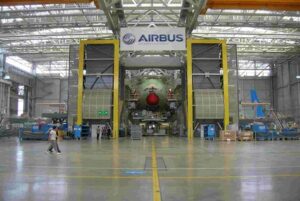
In April 2026, there was significant market divergence between the aerospace and automotive sectors. While aerospace has set new records for global air passenger traffic, the automotive market is facing challenges from logistics pressures and higher costs. These are reflected in the stock market, of course.
Aerospace Surges as Automotive Stalls
Data from the trading app indicate strong demand for aerospace shares, pushing Boeing (BA) up by 11.5% through April 22. Airbus (AIR) and Lockheed Martin (LMT) initially gained ground before volatility set in. Airbus still maintains a high valuation in April, while Lockheed fell roughly 10%.
In the automotive sector, the sales stall led to modest, erratic stock movements. General Motors (GM) hit a 5.3% month-on-month increase, while Ford (F) went up by 10.2% in the same period. Tesla (TSLA) dropped nearly 10% in the first 8 days of April following a disappointing Q1 2026 delivery report.
Structural Growth Phase for Aerospace and Defense
In April, the aerospace and defense industry hit a structural growth phase that has clearly improved the market value in 2026. This started with recoveries in global commercial passenger traffic and aircraft order backlogs, boosting investor confidence. Air traffic has hit new levels since 2019, pushing revenue forecasts to $900 billion in 2026.
Governments and private investors also stepped up defense spending, pushing industry-wide growth higher. 2026 has seen heavy investments in next-gen air defense systems and AI-enabled aircraft. The AI market in aviation alone is worth $8.83 billion in 2026 and has now moved from experimental pilots to industrial deployments.
April also saw strong interest in drones and space programs globally, especially in the U.S. and the Middle East. Airbus, Lockheed Martin, and Boeing are investing nearly $40 billion combined into various projects this year. These investments add significant momentum to the aerospace growth recorded so far in 2026.
Automotive Industry in the Survival Market in April
In a rather diverging trend, automotive declined in April, with flat global sales recorded not just in the U.S., but also in Asia and Europe. Global light-vehicle sales, for instance, are expected to remain flat at about 90.8 million units this year.
In North America alone, sales dropped by 590,000 due to price hikes, leading to muted demand. Although expected, following the expiration of the U.S. Federal electric vehicle (EV) incentives on September 30, 2025. The expiration has sharpened cost hikes for manufacturers and consumers alike. The former have been forced to lower profit margins while the latter still struggle to improve demand.
The Chinese EV market, on the other hand, is facing stalled sales due to increased competition and structural overcapacity. After overproducing by 20 million units, Chinese auto makers are now facing a consolidation phase marked by a 18.3% year-on-year decline in Q1 2026. This is due to domestic market saturation and resulting low factory utilization rates (approximately 50%, well below the 80% breakeven threshold).

What’s driving the Divergence between Aerospace and Automotive Growth in 2026
- Defense spending and AI Automation: Defense spending and the AI race are among the biggest factors driving global aviation sector growth. The race to fully automated AI systems, especially for defense, is impacting other industries, such as the semiconductor market and supply chain. Governments are investing more to improve their computing capacity, driving up the demand for resources and talents.Germany, the U.S., NATO countries in the Baltic, India, Russia, and China have all increased their defense spending, with funds allocated to aerospace programs, research, and development.U.S. aviation AI spending will reach $4.13 billion in 2026, maintaining North America’s position as the world’s largest aviation market. China, India, and Japan lead the Asia-Pacific market, with smart airports and AI-enabled flight automation. Asia-Pacific had a 50.8% CAGR in 2025.
- Supply chain disruptions: Aerospace is still delivering despite bottlenecks, but automotive is struggling with disruptions since 2025. This makes a big difference in the path that either sector took in April.The aviation market saw a strong demand boost as manufacturers began fulfilling the backlog of orders from 7 years ago, driving up demand for narrow-body aircraft. Another major factor in April is the Iran-U.S. war, which temporarily pushed up the price of jet fuel and flight tickets in many countries. Yet flight sales didn’t tank.In the vehicle market, the impact of supply chain woes from 2025 is still felt, especially by car makers. Ford, for example, is struggling to meet orders for its F-150 due to the Novelis plant fire last year. Ford expects the disruption to cost $2 billion in losses this year.
Industry Outlook for 2026
The aviation and automotive markets will focus on maintaining and restoring sales, respectively. In Q3 and Q4, aviation leaders will be looking to change how aircraft fly and not just to meet new orders. There is increased focus on advanced air mobility (eVTOL), and the niche leaders could get the final FAA and EASA type certification milestones this year.
Sustainable aviation is another area where aviation will make progress this year. The SAF “off-take” agreement will see major carriers like United and Lufthansa secure 5-year deals for improved carbon credits
In the automotive industry, car makers are turning to hybrid vehicles to stimulate sales and meet the demand trends. These HEV (Hybrid) and PHEV (Plug-in Hybrid) cars will improve the conditions currently facing our EV sales globally.
What This Means for Investors Going Forward
Despite widespread supply chain disruptions, the aviation sector had an enviable run in April, breaking records and setting up a strong foundation for the year. And while EV sales have struggled this month, the automotive sector could stage a strong comeback through the hybrid models. These will impact the stock market differently, providing investors the opportunity to ride bullish or bearish trends.