



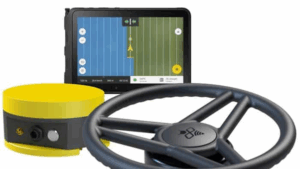
An RTK GNSS receiver is one of the core components of a precision farming system. It receives satellite signals and calculates coordinates with corrections from the base station. Thanks to centimetre-level positioning accuracy, agricultural machinery can move strictly along pre-defined routes, significantly improving the efficiency and precision of various agrotechnical operations.
The receiver is essential for autosteering systems, variable-rate fertiliser and pesticide application, precision seeding, and numerous other tasks where accuracy down to each row and metre of the field is crucial. In this article, we explore in detail why a farm needs an RTK GNSS receiver and what functions it performs in real field conditions.
Centimetre-Accurate Machinery Guidance
An RTK GPS receiver enables agricultural machinery to move across the field with minimal deviation from the prescribed path — achieving accuracy of 2–3 centimetres. This is particularly important when working with narrow row spacing, variable-rate applications, and multiple passes along the same route. The machine precisely follows the predetermined track, eliminating overlaps and skips, ensuring uniform field coverage and consistently high operational quality.
Increased Yields and Higher Farm Profitability
Thanks to the high precision of all agricultural operations, the RTK GNSS receiver directly contributes to higher yields. Seeds are sown evenly, plants receive equal access to resources, and losses during fertiliser application and crop treatment are minimised. As a result, harvest volumes grow steadily while input costs are reduced, making the farm more profitable and resilient to market fluctuations.
Maximum Accuracy in Seeding and Inter-Row Cultivation
During seeding, the RTK GNSS receiver ensures precise placement of seeds according to the planned scheme. Each plant receives its calculated space, creating optimal conditions for development. Later, the exact movement of machinery between rows allows for cultivation without damaging crops: soil loosening, weed control, and fertiliser application become highly effective and safe for growing plants.
Full Automation of Agricultural Machinery
The RTK GNSS receiver forms the foundation for autosteering systems used in agricultural equipment. It enables tractors, seeders, sprayers, and other machines to operate without constant operator involvement, following predefined routes and application parameters. This simplifies the operator’s work, reduces fatigue, and allows operations to be carried out even in low-visibility conditions — at night, in fog, or during adverse weather.
Reduced Consumption of Fuel, Inputs, and Time
The precision navigation provided by the RTK GNSS receiver significantly reduces resource overuse. Eliminating overlaps during seeding and fertiliser application lowers seed and agrochemical consumption. Efficient route planning shortens working time and reduces fuel costs. Altogether, this results in considerable savings and allows for more efficient use of both machinery and personnel time.
Stable Operation on Challenging Terrain and in All Weather Conditions
The RTK GNSS receiver maintains reliable accuracy even on hilly, uneven, or complex field surfaces where standard navigation may fail. The signal remains highly stable during cloudy weather, poor visibility, and near forest belts or structures. This ensures high-quality, safe execution of agrotechnical operations under any conditions, minimising human error and operational risks.