




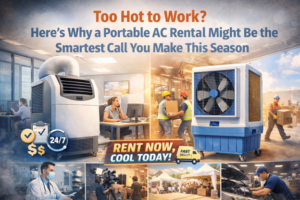
Whether your office HVAC just gave out, you’re setting up a temporary event space, or your warehouse crew is sweating through a Texas summer — the answer isn’t always a permanent fix. Sometimes, what you really need is something ready today, sized right, and gone when you’re done. That’s where portable AC rental comes in.
This guide breaks down how it works, who it’s for, and how to pick the right type of cooling — including when an evaporative cooler might serve you better than a traditional unit.
What Is Portable AC Rental, Exactly?
Simply put, it’s renting a self-contained cooling unit that you can set up without major installation. No ductwork, no contractors drilling into walls, no waiting weeks for a quote. You call, a provider delivers and sets it up sometimes the same day — and you’re cooling within hours.
These units work by pulling warm air in, passing it over a refrigerant coil, and exhausting the heat out through a duct or exhaust hose. The result is a noticeably cooler space — even in large industrial environments.
Businesses use them for emergencies when a central system fails, planned events where permanent cooling doesn’t exist, construction projects, server rooms, pop-up retail spaces, and film sets. The list is long because the need is genuinely common.
Why Renting Makes More Sense Than Buying (Most of the Time)
A lot of people immediately assume buying is cheaper long-term. Sometimes it is — but often it isn’t, especially when the need is seasonal or project-based. Here’s the honest breakdown:
- No upfront capital expense — renting is an operational cost, not a capital one
- No storage, maintenance, or depreciation headaches between uses
- Right-sizing for the job — rent a bigger unit for a hot warehouse month, a smaller one for a server closet
- Access to newer, more efficient equipment without ownership
For businesses that need cooling for a few days, a season, or an unpredictable stretch of time — renting is usually the sharper financial move.
Traditional AC vs. Evaporative Cooler Rentals — Which One Do You Actually Need?
This is where a lot of people get tripped up. Not every situation calls for a refrigerant-based air conditioner. In some cases, an evaporative cooler rental is more efficient, more cost-effective, and surprisingly more powerful.
How Evaporative Coolers Work
Instead of refrigerant, evaporative coolers (also called swamp coolers) use water and a fan. Hot, dry air passes through water-soaked pads, which cools it through evaporation. The output is cooler, slightly humid air — at a fraction of the energy cost.
When to Choose Evaporative Cooler Rentals
- Outdoor or semi-open environments (warehouses with open loading docks, outdoor events, construction sites)
- Dry climates where humidity is low — evaporative cooling is most effective in arid conditions
- When energy cost is a concern — these units can use up to 75% less electricity than compressor-based ACs
- Large square footage with moving air rather than sealed climate control
If you’re cooling a sealed office or a data center, a traditional portable AC is the right call. But if you’re trying to keep 50 warehouse workers comfortable in a space that’s never fully sealed — evaporative cooler rentals might be your best move.
What to Look for When You Rent an Air Conditioner
Not all rentals are equal. Here’s what separates a smooth experience from a frustrating one:
1. Same-Day or Next-Day Delivery
If your AC fails mid-July in Dallas, you don’t have time to wait four days. A good rental provider will have 24/7 dispatch and the ability to get equipment to you fast — ideally with setup included.
2. Proper Sizing for Your Space
Bigger isn’t always better. An oversized unit will short-cycle — turning on and off too frequently without properly dehumidifying the space. An undersized one won’t keep up. A reputable provider will ask about your square footage, ceiling height, insulation, and heat sources before recommending a unit.
3. End-to-End Service
Delivery alone isn’t enough. The unit needs to be positioned, ducted if necessary, and confirmed operational before the crew leaves. Ask upfront whether setup is included or billed separately.
4. Flexible Terms
You might need cooling for three days or three months. Make sure the rental agreement accommodates your actual timeline — not a rigid contract that penalizes you for returning equipment early.
Industries That Rely on This More Than You’d Think
Portable cooling rentals aren’t just for emergencies. Plenty of industries build them into regular operations:
- Healthcare: Hospitals and labs can’t afford temperature fluctuations — temporary cooling bridges the gap during HVAC maintenance or equipment failure
- Manufacturing: Machinery generates substantial heat; targeted cooling protects both equipment and workers
- Events: Outdoor weddings, trade shows, and festivals often have zero built-in HVAC — rental fills the gap
- Film & Production: Camera crews and lighting equipment both generate heat; a comfortable set is a productive one
- Automotive: Service bays get brutally hot in summer — a spot cooler keeps technicians working efficiently
Quick Decision Guide
- Sealed indoor space (office, server room, medical facility) → Traditional portable AC rental
- Large open or semi-open space in a dry climate → Evaporative cooler rental
- Short-term or seasonal need → Rent, don’t buy
- Emergency situation → Call a provider with 24/7 dispatch and same-day delivery
The Bottom Line
Heat doesn’t wait, and neither should your cooling solution. Whether you need a standard portable AC rental for a sealed space or evaporative cooler rentals for an open industrial environment — the flexibility of renting means you get the right equipment, right now, without locking yourself into a purchase you may only need for a season.
The key is working with a provider who understands your space, can size the equipment properly, and shows up fast. When those three things come together, temporary cooling stops feeling like a compromise — and starts feeling like the obvious choice.