





It’s estimated that the U.S. lawsuit system costs businesses $160 billion a year in direct legal expenses and lost revenue from legal uncertainty. One in five small businesses is expected to lose more than $5,000 in 2025–26 alone because of legal missteps.
Most of those losses stem from hidden risks buried in contracts that go unnoticed until it’s too late — seemingly great deals that turn into ticking time bombs.
In this article we’ll:
- Spotlight the biggest traps
- Walk through a simple contract-review process to avoid them
- Show you how AI can flag the standard pitfalls before you sign
Contract Dangers Hidden in Plain Sight
These common but costly clauses are easy to miss—scrutinize every contract for them.
Auto-renewal clauses
Auto-renewal clauses often hide in the termination sections. These typically require 60-90 days’ written notice before your contract anniversary, and if you miss that window, you’re stuck for another cycle—sometimes at a higher price than you originally agreed to. The catch is that the notice deadline usually passes before you even realize your contract is coming up for renewal.
Penalty clauses
Penalties can seem minor — until you do the math. For instance, a 2% monthly late fee adds up to almost 27% a year. The bigger issue is that in some contracts, the definition of a “breach” is vague, leaving it up to the other party to decide when you’ve violated the terms. That gives them leverage to renegotiate or terminate the agreement whenever they choose.
Processing or administrative charges
These charges rarely come with clear caps or definitions, and in practice, they often function more like hidden fees. For example, “reasonable additional expenses” might include something like a venue adding a 22% service charge—buried as a single line in an eight-page contract.
IP ownership traps
Unfortunately, this is quite common in creative work. A contract might specify that the vendor owns all derivative works—meaning they also own any improvements made to your original ideas. In practice, this means that if you pay them to enhance your own intellectual property, they could end up owning the result and effectively taking control of your original work.
Jurisdiction clauses
Hidden jurisdiction clauses can require you to litigate in another state or even another country, where the laws may be very different. Not only could this cost you thousands in travel and local legal fees, but provisions that seem fair or enforceable under your own jurisdiction might be interpreted completely differently where the dispute is actually heard.
How to Review A Contract in 5 Steps
Reviewing a contract is a lot like editing an article. You read it many times, and each time you focus on one thing. We’ve prepared a 5-step review process to help you spot these mistakes. Use it for every agreement that you sign, instead of just scanning it.
- Identify renewal terms. Find the termination section. Note the renewal language. Is it automatic? What is the notice period? Then, mark that date in your calendar.
- Follow all money references. Read every fee, cost, and charge mentioned. Highlight undefined terms.
- Examine performance clauses. What constitutes a breach and who decides that? Are there cure periods?
- Check assignment provisions. If you’re a startup seeking acquisition, a clause that prohibits assignment without consent can kill your exit.
- Verify notice requirements. Specifically, pay attention to: where must notices be sent and can the other party unilaterally change the address?
An important note: The business contract review process can be lengthy — four to five hours even for smaller agreements. For large, enterprise-level contracts, this can stretch into months of back-and-forth involving entire teams of paralegals and senior lawyers. And even then, the process isn’t entirely free from errors as it ultimately comes down to human judgment.
The Limits of Human Review
Even the most experienced attorneys can miss details. This is not because they are careless, but because they are human.
For example, a lawyer might spend 90 minutes reviewing a 15-page agreement when, in reality, it needs three hours. This could be because they are short on time or because they underestimate how much time is required for a thorough review before the deadline. Unfortunately, these things happen to even the best of us.
Moreover, during the review, lawyers tend to focus on major risks such as:
- Indemnification
- IP assignments
- Jurisdiction issues
This happens because that is how they are trained to work. Consequently, a time-pressed lawyer may overlook a minor detail, such as a change in the notice period from 30 to 45 days in the final version.
Furthermore, legal professionals charge upwards of $200 per hour in the US, so most small businesses simply cannot afford a line-by-line legal review of routine agreements. This is where AI contract review tools can be valuable.
What is Contract Review Software?
Contract review software is an alternative to manual review. These AI-powered tools use artificial intelligence and machine learning to identify potential issues in contracts.
This type of automation has become commonplace in the legal world. It is used by major law firms such as Latham & Watkins and many others to automate the preliminary screening of contracts. In some cases, it can even replace the work of paralegals.
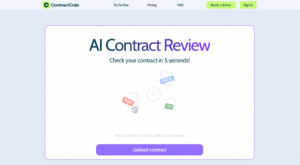
Contract review software, such as ContractCrab, uses artificial intelligence — tools like ChatGPT, for example — to read through your contracts, extract key details such as party names, payment terms, important dates, and obligations, and present them in a clear, easy-to-understand summary. It also flags anything that looks unusual or potentially risky.
Using contract a contract review service might involve the following steps:
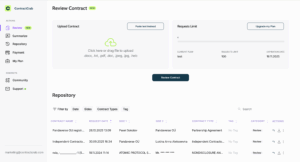
- You first upload your contract, usually in PDF, DOCX, or TXT format.
- Then, you wait a few moments while the AI analyzes the document and extracts key information.
- Finally, within minutes, you’ll receive a detailed summary directly within the platform.
Then, the software provides a detailed analysis, which can take various forms. Some tools send results via email, while others conduct a contract review directly on the website — ContractCrab, for example, operates in this way.
How to Choose a Contract Review Tool?
When choosing an online contract review tool, consider the following:
- Pricing structure
- Flexibility
- How simple it is to get started
Since many contract review tools are designed for legal professionals, they tend to be costly and require a lot of overhead, such as an onboarding call and integration, just to get started. Small businesses should look for tools that they can start using right away, such as ContractCrab, which can be used immediately after signing up and offers a free trial.
For flexibility, consider subscription options to save money. With a subscription, you pay less per document; for example, with ContractCrab, you pay $0.15 per contract.
Finally, in terms of ease of use, look for tools that provide detailed yet easy-to-understand insights.
For example, certain contract review tools designed for lawyers might help you find citations and cases that support arguments, but this is not useful for a small business looking to spot hidden pitfalls in standard agreements — information like that is completely unnecessary.
Such tools also tend to be much more expensive, so you’d be paying a premium for something you don’t need.
Bottom Line
Businesses lose $160 billion annually due to legal expenses in the US alone, many of which stem from overlooked hidden dangers in contracts. Most commonly, issues lurking in seemingly safe contracts include:
- Auto-renewal clauses
- Penalty clauses
- Processing or administrative charges
- IP ownership rights
- Mismatches of your jurisdiction and contract jurisdiction
Although mistakes from underreviewed contracts often occur due to human error, even among professional lawyers, one way to avoid them is to carefully review contracts using a checklist, such as the one we’ve shared above. The safest way to avoid mistakes is to use automated contract review as part of your process, either as the only review you perform or as a preliminary check to assist your lawyer with manual reviews. This doesn’t cost much, especially if you choose the subscription option, but it can save you thousands of dollars in legal expenses down the line.