

 The signing of the Declaration of Independence in 1776 – marking our official break from British rule – was celebrated for the first time with cannon fire, public readings of the Declaration, church bells, fireworks, and music in the streets. Subsequent July 4th celebrations often added parades, military displays, speeches, and re-enactments. But those early years were not the only time in American history that a party atmosphere was appropriate and likely won’t be the last. With the July 4th holiday approaching in our sesquicentennial year, let’s salute the American spirit with a countdown of some of the traditional – and not so traditional – ways we have marked major party-worthy events throughout the years.
Stars and Stripes Forever
Whether they’re the small hand-held size, the front-yard flagpole size, or the massive stadium size, the American flag is a natural addition to any grand event. For the 1976 bicentennial, an Avenue of Flags was created at Mount Rushmore with 56 flags representing 50 states, one district, three territories, and two commonwealths. To celebrate the 1996 Olympics, the world’s largest flag at the time (weighing 3000 pounds, 505’ x 255’ in size with stars 17’ high) was hung on cables over Hoover Dam as the Olympic torch passed by on its journey to Atlanta. For the upcoming 4th of July, expect to see the 60’x90’ George Washington Bridge Flag suspended from a cable over the GWB. And if you happen to be in Utah for the 4th of July, you can see Big Betsy, a 78’x150’ American flag suspended over Grove Creek Canyon—considered the largest free-flying (not attached to a flagpole) American flag.
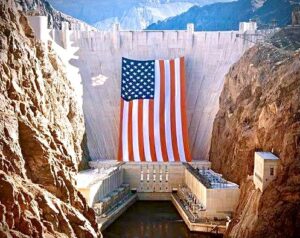
cables over Hoover Dam as the Olympic torch passed by on its journey to Atlanta. Photo Wikipedia
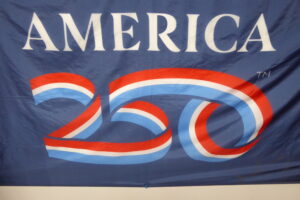
Dan Esposito, Owner, DS Flags; Elmsford: “We installed more flagpoles last year than in previous years with the increase in homeowners getting excited about flying the American Flag. The 250th Anniversary Flags are very popular, especially as towns prepared for Memorial Day celebrations. I’m inspired by our veterans and their respect for the Flag. At our office here we accept and take care of worn Flags, aka: “retired Flags”, and I am always amazed when a veteran brings one to us, respected and folded in the Traditional Triangular fold.”
Gotta Love a Parade
On October 9, 1936, Los Angeles celebrated the first transmission of electricity from Hoover Dam, 266 miles away, with a massive parade on Broadway and the illumination of downtown with bright floodlights. The largest ticker tape parade in American history was held April 21,1951 in New York City for General Douglas MacArthur following his relief from command in Korea: 7 million people; 2,852 tons of paper and ticker tape; and crowds lined along 19 miles of Manhattan. That record still stands.
Parades occurred on water, too. A maritime parade sailed into New York Harbor on July 4th 1976 for the U.S. Bicentennial, the first gathering of its kind in modern American history. “Operation Sail”, with its sixteen tall ships from 14 nations attracted over 6 million spectators and was repeated in 1986 as part of the Statue of Liberty re-dedication. This year, from July 3-8, “Sail 4th 250” will celebrate our 250th anniversary with 16,000 service members and more than 100 ships in New York Harbor (including 30 tall ships and 40 war ships) representing 130 nations around the world.
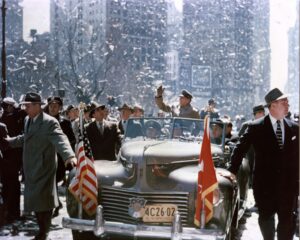
New York City for General Douglas MacArthur following his relief from command
in Korea: Seven million people; 2,852 tons of paper and ticker tape; and crowds
lined along 19 miles of Manhattan. That record still stands. Photo Wikipedia
Kevin Lustik, Tarrytown Harbormaster: “A reminder to all boaters in our area who are planning to see these ships from the water: make sure to review NYS laws and the Special Local Coast Guard Regulations for the East River and Upper New York Bay. And contact the U.S. Coast Guard Auxiliary for free safety inspections.”
Music, Music, Music
The “Star Spangled Banner” was composed as a poem in 1814 by Francis Scott Key after seeing the American flag still aloft following the British bombardment of Fort McHenry during the War of 1812. John Stafford Smith later set the poem to the tune of a popular English song, and it was officially adopted as the United States Anthem in 1931. In 1896, after a trip to Europe made him homesick for the American flag, John Sousa composed “Stars and Stripes Forever” which was officially designated the National March of the United States in 1987 and has become part of the soundtrack for July 4th parades and fireworks. Intended to inspire patriotism during WWII, “Fanfare for the Common Man” by American composer Aaron Copland was written in 1942 for the Cincinnati Symphony and has joined the canon of American patriotic music.
Tim Allport, Tarrytown; French horn player and 35-year member of Westchester Symphonic Winds: “When you hear a marching band coming, everyone feels patriotic, stands up, and sings along because everyone knows Sousa’s “Stars and Stripes Forever”, the “National Emblem March”, “You’re a Grand Old Flag,” “Yankee Doodle”, the “Battle Hymn of the Republic,” “This Land is Your Land,” and all the military anthems. Marching bands are a crowd pleaser: you can’t sleep when a marching band goes by; it stirs something inside you.”
Going “Live”
The first official coast-to-coast national radio broadcast took place January 1,1927 when the newly-formed National Broadcasting Company (NBC) aired the Rose Bowl football game from Pasadena, California. People across the country could listen and be part of an event “live” for the first time in American history. Radio caught on quickly: 8 million radios were sold between 1922 and 1928. An NBC radio program guide for the week of July 1-7, 1928 listed the “Star Spangled Banner”, selections from popular musicals like “Yankee Doodle Dandy”, and celebrations of Stephen Foster’s music “Oh! Susanna”, “Beautiful Dreamer”, and “My Old Kentucky Home”. On April 30,1939, RCA introduced the first, regularly scheduled television service in the United States from a transmitter atop the Empire State Building. With the introduction of television, audiences could now see and hear events as they happened throughout America. After World War II, ownership of television sets jumped from a few thousand in 1946 to over half of all US households by 1955. The opening of Disneyland on July 17,1955 was celebrated with a massive star-studded live television special on ABC watched by 70-90 million people – one of the largest remote broadcasts in television history at the time.
Professor Louis Grasso, Program Director, Media Studies; Mercy University, Dobbs Ferry: “These advances in communication technology over the years means that all of us now benefit in real time from a shared experience while not being in a shared location-creating a community larger than our neighborhood, larger than our country.”
Picnics, Punch, and Ice Cream
For any celebration to be complete, food makes an appearance in one form or another. “Election Cake” – a rich and spicy fruit-filled confection encouraged patriots to come vote and celebrate elections after the Revolutionary War. A punch made from rum, citrus, and sugar was served as part of Washington’s inauguration celebration. The completion of the US Capital in Washington, D.C. was celebrated on September 18,1793 with a procession, 35-gun salute, and ended with a barbecue. When the nation was celebrating its 30th anniversary on July 4th,1806, President Thomas Jefferson served ice cream at a White House event by keeping his personal ice cream maker churning all day. His four-ingredient recipe for vanilla ice cream (cream, egg yolks, sugar, and an imported French vanilla bean) is archived for posterity at the Library of Congress.
Marlaina Bertolacci, co-owner, Main Street Sweets, Tarrytown: “We’re creating a whole line of 4th of July treats to help our neighbors enjoy homemade ice cream flavors and cake designs in patriotic rainbows of red, white, and blue. We’ll be open on the holiday, so the community can stop by on the 4th or order ahead for at-home celebrations.”
Having a Times Square Ball
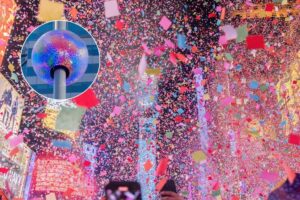
and remains visible in Times Square all year. Photo Wikipedia
Any discussion of celebrations in America has to include at least a mention of New Year’s Eve in Times Square. The dropping of an iron and wood ball with 100 lightbulbs from a flagpole on top of One Times Square started the tradition on December 31, 1907. From 1942-1943 wartime “dimouts” were held while crowds observed a moment of silence. In 1955, the wooden ball was replaced with an aluminum version, and updated in 1995 with rhinestones, computerized lighting, and strobe lights. A massive Waterford crystal ball was designed to ring in the new millennium in 2000. The current permanent ball is 12 feet in diameter, weighs 12,000 pounds, uses 32,000 LED lights, can create 16 million colors, and remains visible in Times Square all year. Now, for the first time in its history, the ball will drop a second time within the year—on the 4th of July. Actually, it will drop 8 times to mark midnight in every US time zone starting with Guam at 10am on July 3, a signature NYC countdown at 11:59pm, then continuing west and concluding with Samoa at 7am. Although Times Square will not be open for crowds to gather, the event will be televised with celebrations and special guests throughout the live broadcast as part of the 250th anniversary.
Fireworks Work
Some of the largest fireworks displays in America include Macy’s 4th of July fireworks, the National Mall Fireworks on the 4th of July over the Lincoln Memorial in Washington, D.C., the Thunder Over Louisville annual fireworks kicking off the Kentucky Derby Festival, and the Las Vegas Summer Celebration. Even George Washington’s inauguration on April 30,1789 in New York City featured an hour-long fireworks display. New Castle, Pennsylvania is officially recognized as the “Fireworks Capital of America” and home to the major fireworks manufacturers Zambelli and Pyrotecnico.
Fashioning in Red, White, and Blue
With clothing brands promoting flag-themed wearables, red, white, and blue have become signature colors in July 4th clothing options. But it wasn’t always like that. During the Civil War, for example, celebrating July 4th often meant wearing uniforms. As the holiday became a more formalized celebration, attendees at parades and guests at picnics wore “Sunday Best”. Scarcities in America during World War II resulted in more practical approaches to clothing followed by a post-war era of casual styles for the 4th of July: polo shirts and denim.
Kristen Abbatiello and Amy Cappelli, co-owners, Cloth and Curate, Croton-on-Hudson: Fashion is about stepping outside the box and taking chances with your own personal style. This goes for everyday fashion or when you need to dress for those important holidays. As the 4th of July is approaching, step outside the box while keeping a classic yet subtle look. Don’t be literal by wearing a blue top, white pants, and a pair of red shoes; it doesn’t create a flowing seamless look. Instead, a white dress with a pop of color pertaining to the theme, like a handkerchief tied around your purse with a red/blue stripe! Or a white and blue printed dress with a poppy red brooch on the tie of your hairband. You want to make a statement while allowing the fireworks to take front-and- center stage”.
The Party’s Not Over
When the parade, the music, and the fireworks have all concluded, souvenirs serve as reminders that something important happened. Tourist shops offer replicas heralding major events and historic figures. Museums across the country house artifacts for viewing. See George Washington’s original office tent at the Smithsonian. Visit the Cantor Arts Center in California to spot the solid gold spike that was driven into a polished railroad tie to celebrate the completion of the Continental Railway in 1869. The United States Postal Service celebrated the World’s Columbian Exposition in Chicago in 1893 by issuing a commemorative stamp for the first time. More than 3,000 commemoratives have been released by the USPS since then, recognizing people, places, and events in American history: the addition of Alaska and Hawaii as the 49th and 50th states in 1959, the 1969 First Man on the Moon stamp, the creation of the zip code, the 1976 centennial. The USPS typically issues 25 to 35 new stamp subjects each year selected from as many as 50,000 suggestions submitted to the Citizens’ Stamp Advisory Committee. For its 250th Anniversary celebration, the USPS has adopted the American Revolution as a special theme for its commemoratives.
Dan Moriarity, Postmaster; Ardsley Post Office: These 250th anniversary stamps were issued in April, so you can find them now at local post offices or online at www.usps.gov where they are available in a variety of formats including sheets, first day covers, and portfolios.”
However you choose to celebrate this once-in-a-thousand-years milestone on July 4th – a picnic, a parade, a boat ride, or a broadcast special – take pictures and take notice – for America is hosting the biggest party in our nation’s history, and you’re invited.