




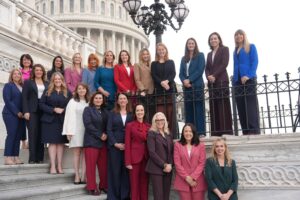
Cait Conley was in Washington, D.C., in mid-November for new member orientation as she prepared to take office Jan. 3, representing the 17th Congressional District.
The Army veteran and former national security official defeated incumbent Republican Mike Lawler on Nov. 3 to win the seat representing most of Westchester’s River Towns.
“We’re already working on how we hit the ground sprinting on January 3rd and not wasting any time to make people’s lives better,” Conley said during a phone interview. “Our priority in every discussion is on what legislation needs to be the first one coming to the floor. It’s focusing on lowering costs and ending corruption.”
Conley, a Millwood Democrat, will join a record number of women from both parties serving in the House of Representatives.
What’s in the 17th Congressional District?
The 17th Congressional District includes all or parts of Rockland, Westchester, Putnam, and Dutchess counties, including Briarcliff Manor, Cortlandt, Croton-on-Hudson, Mount Pleasant New Castle, Ossining, Peekskill, Pleasantville, Sleepy Hollow and Tarrytown.
Here’s a Q&A about Conley’s plans as part of the Democratic majority in the 120th Congress. This interview has been edited for brevity.
River Journal: What were the top issues you heard from residents during the campaign?
Cait Conley: Across the board folks were feeling the pressure of the cost-of-living crisis, and that didn’t start overnight, but with this administration and the 119th congress, what we’ve seen are policies that have exacerbated it. And we see that playing out with things like Trump’s tariffs that have jacked up prices on just regular goods for people all over the district — everything from groceries to home supplies —where you’re seeing the average household paying $4,200 more for the same goods since the tariffs were imposed.
We’ve also seen that burden placed on small businesses, where their input costs are higher. They’re paying fuel surcharges and tariff increases. That’s on top of rising health care costs. Between Medicaid and premium tax credits, the cuts to those programs, we’ve seen nearly 37,000 people in our district who are going to lose health care coverage, and overall, in New York because of Medicaid cuts, that’s nearly half a million people.
There are very real consequences for the policies of this administration and this Congress that we have to mitigate and deal with.
RJ: How will you bring your expertise to bear on the cybersecurity threats that keep occurring?
Conley: The federal government should be playing a more active role in helping our nation raise our cybersecurity readiness. And there are agencies that play a lead role in that, including my former agency, the Cybersecurity and Infrastructure Security Agency. That agency has lead responsibilities in working with critical infrastructure owners and operators. That’s everything from our water facilities, our energy facilities to our health care facilities, to our schools and government facilities, to make sure they can mitigate the cyber and physical threats that may put our critical infrastructure at risk.
But under the Trump Administration, that agency was gutted by one-third at a time when we’re seeing rising cyber threats. This administration is reducing our cybersecurity mandate and that reduces the federal government’s ability to support cybersecurity to our communities.
It’s not right to ask our water or energy providers to defend themselves against Russian or North Korean hackers or Chinese hackers alone. And this is about getting the federal government to help where it has responsibilities to do so.
RJ: What’s your stance on data centers?
Conley: Right now in our Congressional district there are five data centers currently operating in Rockland County, with three more proposed, and in Southern Dutchess County, there are proposals for additional data centers.
I believe that two criteria must be met for a data center to be built. One, a community must approve it being there, and two, it needs to be built in a way that is a net positive, a net benefit to that community. That means that we are not allowing data centers to push utility costs up on the local communities; that we are not allowing data centers to harm the local environment, and overall, it is not exploiting the communities and families that live with them.
What we have seen with corporations is that they are motivated by margins and profits, not necessarily what is right for people. Government’s job is to make sure that public safety, security and wellness is at the forefront.
That’s why I support the moratorium as we figure out the best way forward. Right now our district is supported by the state moratorium, and in the towns, we have seen more local moratoriums addressing data centers that were not covered by the state-level moratorium.
RJ: What about the housing crunch?
Conley: We don’t have a sufficient housing supply to meet the needs of our district, and what we are seeing is how reckless policies, things like tariffs, have jacked up the costs of even existing housing. It costs more to even maintain properties because the cost of material goods have gone up. It costs more to build new homes and apartment buildings because the cost of building materials has gone up.
We also see how increased spending by the federal government has increased our national debt, which is putting upwards pressure on interest rates that impacts people who are trying to buy homes, get a mortgage, even small businesses trying to take out a loan. A lot of things factor into the housing crisis, so all of these things have to be taken into consideration as we look at how to solve it.
RJ: What committees are you hoping to serve on?
Conley: Right now, committees are still under discussion. At the end of the day, the biggest issues that are impacting our district are not specific to any committee. We’re going to see a very active 120th congress that’s going to be voting on some really important issues, like our budget, like restoring Medicaid funding and premium tax credits, like passing hopefully campaign finance reform, and rooting out corruption, and those things are not specific to any committee.