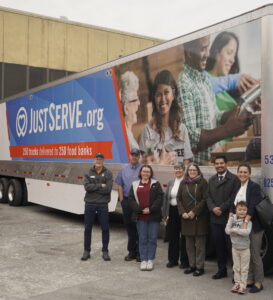
 The drive from Salt Lake City ended late Wednesday night. After arriving at Feeding Westchester’s distribution center, the Desert Transportation driver backed his 80-foot trailer up to the loading dock and rested for a few hours before the work began. The payload: 40,000 pounds of shelf-stable food, grown, produced, and packaged in Utah and soon to be provided to neighbors in need across Westchester County.
As the sun rose on the morning of March 19, Feeding Westchester’s operations team unloaded the shipment and began inventory and sorting in their 62,000 square-foot facility in Elmsford. The donated food will be incorporated into Feeding Westchester deliveries across their network of 175 partner agencies, including food pantries, soup kitchens, schools, community centers and mobile distributions.
The donation was made by The Church of Jesus Christ of Latter-day Saints as part of a nationwide initiative, in collaboration with the America250 celebration and the America Gives Initiative. In 2026, the Church is coordinating 250 truck full truckloads of food to 250 food banks across all 50 states. Each truckload in the initiative provides enough food to feed approximately 1,400 people for one week. In total, the program will contribute 10 million meals nationwide.
Local representatives from the Church attended the delivery, including Nadia Katene, Relief Society President, Westchester Ward, and Cristian Romero, Assistant Director, New York State Faith Office.
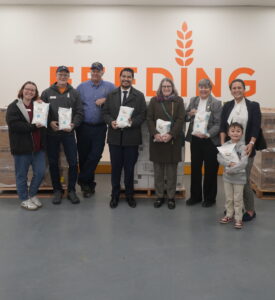 The effort is also supported by JustServe.org, a community service platform sponsored by The Church of Jesus Christ of Latter-day Saints that connects volunteers with local service opportunities. The initiative reflects a broader commitment to service in recognition of the America250 celebration.
Feeding Westchester will distribute the donated food in the coming weeks as part of its ongoing work to address hunger in the county, where more than 1 in 3 households are at risk of hunger.