


Teatown Lake Reservation has been awarded a three-year, $1.5 million grant to advance two innovative forest restoration research projects.
The funding provided by a private foundation will support new scientific initiatives aimed at developing effective strategies to restore forests impacted by emerging diseases and invasive species.
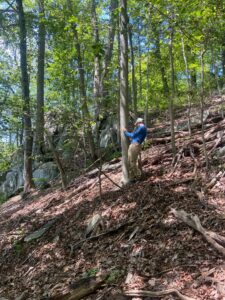
Addressing one of the most urgent threats facing Eastern forests, the first project will study the most efficient and affordable methods for restoring forests impacted by Beech Leaf Disease. This emerging disease has caused widespread mortality in American beech trees across the Northeast and effective restoration strategies are crucial to minimize the risk of opportunistic invasives spreading into the resulting forest canopy gaps.
The loss of American beech trees triggers cascading damage throughout forest ecosystems, affecting wildlife, soil health, and opening the door for invasive species to alter the ecosystem.
“This is an issue that land managers throughout the region are grappling with. The anticipated widespread loss of American beech, a major forest canopy species, will create yet another pressure on our forests, compounded by the impacts of invasive plant species and excessive deer herbivory. Through this study, we’ll be testing different approaches to ‘patching’ these canopy gaps and encouraging native regeneration in order to inform practical and effective forest habitat management at Teatown and beyond,” said Amy Karpati, Teatown’s senior science advisor.
The funding will support a second project that investigates a new strategy for reintroducing missing native plant species by leveraging the pathways that allow invasive species to spread. The goal is to ultimately find a low-tech and potentially scalable solution that could improve restoration approaches.
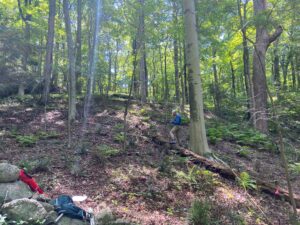
“Traditionally, habitat restoration focuses on removing invasive plants from habitat interiors and replanting with native plants, but this leaves unaddressed the continuous pressure from invasive sources along edges, neighboring properties, and corridors. This research aims to test whether strategically planting natives in these edge areas and corridors can leverage natural dispersal pathways to spread into habitat interiors, potentially offering a more cost-effective restoration approach. The findings will guide land trusts and land stewards on optimal site selection for native plantings, either validating this new edge-focused strategy or reaffirming traditional habitat restoration of interiors,” said Thom Almendinger, Teatown’s director of stewardship.
Both projects will pioneer new approaches to forest restoration, with findings that could inform conservation strategy far beyond Teatown – further strengthening its position as a leader in environmental stewardship and innovation.
These projects are taking place alongside Teatown’s $26 million project that includes adding a state-of-the-art education center, renovating the Nature Center, making trails more accessible and relocating parking areas.
The nonprofit environmental education center and nature preserve, comprises 15 miles of hiking trails and more than 1,000 acres of protected land, a two-acre island refuge for more than 230 species of native wildflowers, wildlife exhibits, science and stewardship projects, nature classes and camps.
Teatown, with Ossining address, comprises a campus that stretches into the towns of Cortlandt, New Castle and Yorktown.