


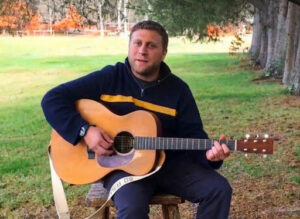
For more than 25 years, music was part of nearly everything Greg Kellner did. He sang, played acoustic guitar and used music to connect with the children and communities he worked with. After undergoing surgery for a brain tumor in 2019, he could no longer sing or play guitar as he once had.
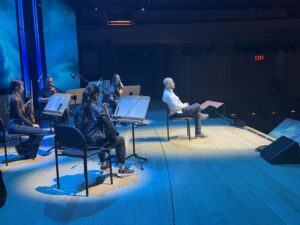
On Nov. 11, Kellner performed at the ElevenLabs Summit at Lincoln Center in New York City using an AI-generated version of his own singing voice. The experience was something he once thought would never be possible again.
Kellner, who has lived in Briarcliff Manor for a little more than three years with his wife and two young daughters, has been a musician since childhood. At 11, he asked his parents for a guitar and lessons and joined his middle school chorus. His interest eventually led him to earn a degree in Voice and Music Technology from American University.
Throughout his career, Kellner incorporated music into his work as an educator and camp leader. He directed music programs at several camps and became the founding director of URJ 6 Points Sci-Tech Academy.
Following his surgery in 2019, Kellner developed speech and physical disabilities that affected his ability to communicate and make music.
“What at one time brought me so much joy now brought so much frustration,” Kellner said.
He spent more than two years in speech therapy, including treatment at Burke Rehabilitation Hospital in White Plains, and also participated in occupational therapy for guitar playing and voice therapy for singing.
His introduction to AI voice technology came while searching for a more natural way to narrate educational videos. He had previously relied on recordings that sounded robotic and wanted something closer to his own voice.
Kellner eventually discovered ElevenLabs, an AI audio company, and joined its Impact Program, which helps people with speech disabilities access voice technology.
Through the program, he began working with Richard Cave, a speech-language pathologist at ElevenLabs. Using recordings from before his surgery, including several from his years working at summer camps, they worked to recreate his voice through AI.
The process took several attempts before Kellner was satisfied with the results.
Hearing his reconstructed voice for the first time was something he had once thought impossible.
“The most meaningful part has been realizing that AI did not replace my voice, but rather restored my ability to express my identity and connect authentically with people,” Kellner said.
He recalled showing the technology to his father without explaining what he had been working on. After asking his father to type a few words and listen to the generated speech, Kellner asked him to identify the speaker.
His father was surprised and asked, “Is that you?”
The technology has also changed how Kellner manages everyday communication. Along with his speech disability, physical coordination challenges make reading and writing difficult.
He now uses AI-assisted writing, dictation and screen-reading tools to communicate more easily.
“Many people use text-editing/creation, AI-powered dictation, and more natural sounding AI-Screen readers for efficiency, but for me, without these tools, reading and writing would be nearly impossible,” he said.
Kellner hopes his experience will encourage people to look beyond the most visible forms of disability.
“Sometimes people interpret my slow speech as a sign that I’m not smart or able to contribute to a discussion,” he said.
He explained that people often do not realize he has a disability until they hear him speak. When possible, he sends information ahead of meetings to help others understand how to communicate with him.
Reflecting on his Lincoln Center experience where he performed a song he created using his reconstructed singing voice and guitar, with live backing instruments, Kellner described it as “Surreal, magical, amazing, indescribable.”
“Looking out at the audience and seeing thousands of people was just unbelievable,” he said.
He also recalled how supportive everyone involved in the event had been, from company executives to stagehands. He said it was clear that the staff who helped put the performance together believed in the work they were doing.
At the end of his performance, Kellner received a standing ovation. While the audience response meant a great deal to him, he said the experience represented something much larger than returning to the stage.
“For me it’s not about the song or being able to perform. It is about dignity, self-esteem, and identity for any person with a disability,” Kellner said.
Before the performance, Kellner had been messaging Cave about their preparations. During one exchange, Cave told him, “Together we will change the world.”
After performing at Lincoln Center, Kellner said those words carried even more meaning.
When he first received the invitation to perform, Kellner had contacted Cave to make sure it was real.
“This is a dream come true I never had because I didn’t think it was possible,” he recalled saying.
His song is also expected to appear on an album ElevenLabs plans to release in December.
Looking ahead, Kellner hopes to create an album of original songs using his AI-generated voice.
For Kellner, technology has provided more than a way to return to music. It has helped him reconnect with an important part of his identity while making everyday communication more accessible.
“Creativity and personal mission do not have to end just because of disabilities,” he said. “Technology can open unexpected doors.”