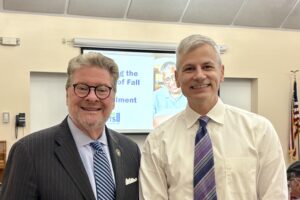
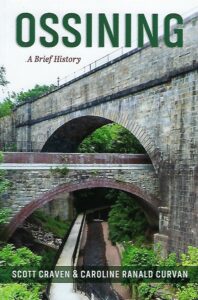
 Scott Craven has a voice that can direct traffic or disperse a crowd—handy during his career as an Ossining police captain. The retired officer required no microphone to captivate a hometown crowd, along with co-author Carolyn Ranald Curven, at the Feb. 22 launch of their literary collaboration, Ossining: A Brief History (2026, The History Press).
While Craven & Curven may sound like a dastardly law firm from dark, Dickensian London, in fact, the authors are a good literary team: Craven was born and raised in Ossining, and Curven has served three years as the town historian. It’s their second go-round in local history: 2022’s Croton Point Park: Westchester’s Jewel on the Hudson was also a deep dive into local legends and lore.
The lecture at the Ossining Public Library began with Craven, now a Library assistant, unveiling a fistful of shibboleths—code words only locals use, such as a meatball wedge, Route “a-hundred,” and a hard lean on the “a” in “aqueduct.” Appreciative natives nodded at the usage.
Craven, a self-confessed geology fan, began by discussing the true cornerstones of the town, the three rock types upon which Ossining was built: gneiss, schist, and Sing Sing marble, the latter of which he called “the economic driver of the community … and the reason for Sing Sing Prison.” He pointed out how to spot the rectangular sections of the soft marble, all of which was hewn by hand in the 19th century, often by unhappy prisoners.

Our history is malleable, though: The marble may be a foundational rock of the town, but in some places, it’s melting away, or “sugaring.” Headstones at historic cemeteries like Sparta are being slowly eaten away by acidic rain, and there’s little the Ossining Historic Cemetery Conservancy—or anyone else–can do about it.
Curven dug even deeper into Ossining’s soil, speaking of the thrill in holding shards of Native American pottery, dating to 400 AD, from the Piping Rock area of town. She briefly touched on the area’s indigenous heritage, relating how the Munsee speakers just seemed to fade from history, disappearing with much less contention than the controversial (retired) school mascot, the Ossining Indian.
Captain Craven returned to the stage with a map and a food analogy, explaining how Ossining resembled a triangular pizza slice and the Hudson River, the crust. He noted that police officers are truly the ones who know the rabbit’s warren of boundaries crisscrossing an area comprising multiple school districts, voting districts, etc. and surmised why the Town of North Castle actually has 1.5’ of territory bordering the Croton River (and also how one might pass from Ossining, over Yorktown, into North Castle in one giant leap).
Curven returned to a theme which she discussed at her OPL “Fireside Chat” in 2024, the street names of Ossining, a topic which comprises an appendix in the new book. She explained how streets like Feeny and Bayden were named for veterans who died in World War II, the stars on the street markers indicating their service to the country. The authors had touched on the area’s Revolutionary War era in a January talk at OPL entitled “Ossining and the Neutral Ground,” each role-playing Tories and Rebels with gusto.
Oddities like the 1,500-pound Parrott Rifle (a small cannon-like device forged at Cold Spring) at Nelson Park and the remaining Ossining trolley barns were discussed, as well as the residency of Carrie Chapman Catt, president of the National American Woman Suffrage Association and founder of the League of Women Voters, who lived for a decade at 20 Ryder Road.
The book also has appendices on local walking tours as well as a listing of churches and schools. As Curven noted in her closing comments, “If you know what you’re looking at, it’s kind of thrilling.” The crowd which queued for autographed books from Hudson Valley Books for Humanity seemed to concur; the authors were swamped.