





The major 2026 development from the U.S. Supreme Court in Montgomery v. Caribe Transport II, LLC concerns federal preemption. It did not make brokers automatically liable. The ruling lets certain state negligent-selection claims tied to motor-vehicle safety proceed, but an injured person still must establish a legal duty and prove that careless carrier selection contributed to the crash.
One serious truck crash can drag in multiple businesses, each with its own responsibilities. One company set up the shipment. Another hauled it. Contracts may reveal who picked the carrier and who gave the driver instructions, and insurance policies can differ from defendant to defendant, covering some while excluding others. Keep the load documents. They matter.
What the 2026 Ruling Changed
This fight is about preemption: can federal transportation law block a state negligent-selection claim against a broker? When federal law already covers an area, preemption knocks out the state-law claim sitting there. Under 49 U.S.C. § 14501(c), the federal framework limits state regulation of transportation services but preserves certain state motor-vehicle safety powers.
That safety carve-out sits at the heart of the dispute.
Florida sits in the Eleventh Circuit. In Aspen American Insurance Co. v. Landstar Ranger, Inc., the court preempted a negligent-selection claim that involved stolen cargo. That 2023 decision concerned access to a claim; it never found that a broker caused a highway collision. Motor-vehicle-safety personal-injury claims raise different questions.
Surviving a preemption defense does not end the case. Florida law still requires proof of every element, and the claimant must tie the broker’s conduct to the collision.
Why the broker-carrier distinction matters
Carriers haul the freight. Brokers arrange transportation between a shipper and a carrier, and the shipper tenders the goods. The paperwork and how each business actually behaved show who played which role in the disputed shipment.
Can a Freight Broker Be Sued After a Truck Accident?
Yes, if the facts support a recognized negligence theory and federal law does not preempt it. Being named as a defendant proves nothing. A complaint contains allegations, not findings.
The 2026 ruling allows negligent-selection claims involving motor-vehicle safety to proceed. It does not establish liability. The injured motorist still bears the burden of establishing freight broker liability and must show the broker’s carrier choice was unreasonable and connected to the crash.
What freight broker negligent-selection claims require
Florida’s general negligence framework demands duty, breach, causation, and damages, as Clay Electric Cooperative, Inc. v. Johnson explains. For a broker, the alleged breach usually involves selecting an unsafe carrier. That differs from a carrier’s decision to hire a particular driver.
A claimant can argue the broker knew, or reasonably should have known, about material safety risks when the broker assigned the load. Warning signs include an adverse safety rating or repeated out-of-service violations. Lapsed operating authority and thin insurance also deserve scrutiny. But a single Federal Motor Carrier Safety Administration score alone proves neither negligence nor causation.
Who is liable in a freight broker accident?
 Responsibility may rest with the driver and the motor carrier. A broker answers for its own proven negligence.
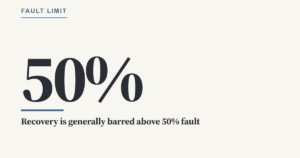
For covered negligence claims filed after March 24, 2023, recovery is generally barred when the claimant exceeds 50% at fault.
Florida’s comparative-fault framework under Fla. Stat. § 768.81 allocates responsibility by fault. For covered negligence claims filed after March 24, 2023, recovery is generally barred when the claimant exceeds 50% at fault. A business’s role in the shipment does not by itself establish fault.
A shipper is never responsible for the carrier’s conduct simply by hiring it. The shipper’s actual operational control may warrant closer scrutiny. Unpaid freight charges are contractual payment obligations; they say nothing about who caused a highway crash.
How Do You Prove a Broker Was Negligent?
Proof usually requires records showing what safety information existed at the time of selection, what the broker reviewed, and how an overlooked risk connects to the crash. Timing matters here. Evidence created afterward cannot establish what the broker knew beforehand.
- Broker-carrier agreements, load confirmations, and onboarding records
- Operating authority, safety ratings, inspection results, and out-of-service data available at dispatch
- Internal carrier scorecards, approval rules, audit trails, and exception approvals
- Dispatch communications showing control over routes, schedules, or driver conduct
- Driver qualification materials, electronic logs, maintenance records, and crash evidence held by the carrier
That evidence must connect the selection failure to the crash. Ignored hours-of-service violations can support a fatigue theory yet say little about an unrelated mechanical failure. A poor safety history alone does not explain the collision.
Records vanish under ordinary retention schedules. Dashcam footage and portal messages get overwritten, and different companies may hold separate pieces of the shipment file. A preservation request should name the specific load and records, though no request guarantees everything still exists.
Why Insurance Can Become a Separate Problem
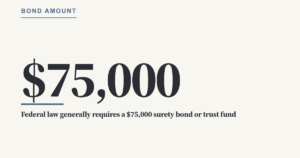 Federal law generally requires a property broker to maintain a $75,000 surety bond or trust fund under 49 U.S.C. § 13906(b). That bond covers brokerage payment obligations. It is not bodily-injury insurance for truck-crash judgments.
Federal law generally requires a property broker to maintain a $75,000 surety bond or trust fund under 49 U.S.C.
A broker can buy contingent auto-liability coverage or another liability policy separately. Coverage hinges on the insured business, the policy language, and the circumstances of the collision. A policy’s existence does not establish coverage for a given claim.
Under 49 C.F.R. § 387.9, interstate for-hire carriers hauling nonhazardous property commonly face a $750,000 federal minimum. That floor applies to vehicles with a gross vehicle weight rating of 10,001 pounds or more. Hazardous cargo requires higher limits. The minimum can fall short after catastrophic injuries, and that shortfall does not turn the broker into a guaranteed source of extra compensation.
Frequently Asked Questions
What can a freight broker be held responsible for?
A broker may face a claim for its own negligent carrier selection, provided federal law permits the claim and the evidence establishes duty, breach, causation, and damages. Florida’s decision in McCain v. Florida Power Corp. separates the foreseeable risks relevant to duty from the causation required for recovery. Arranging a shipment alone does not mean the broker caused an injury.
Must brokers carry crash-liability insurance?
No. No federal rule requires a property broker to carry automobile liability insurance just to hold broker authority. The financial security mandated by 49 C.F.R. § 387.307 is not crash-liability coverage. A broker may buy separate liability insurance; payment then hinges on the policy language and the facts of the claim.
What should someone preserve after a brokered-load crash?
Keep scene photographs, the police report, medical records, witness contact information, and any bill of lading or load number. If a carrier-selection claim looks possible, an attorney may request preservation of broker onboarding files, safety records, load confirmations, and dispatch messages before routine deletion erases them.
What Florida Motorists Should Do Next
A weakened preemption defense changes access to court. It does not create a right to compensation. Recovery still rests on Florida negligence law and evidence tying the broker’s conduct to the injury, and insurance, comparative fault, and filing deadlines each need their own attention. Get appropriate medical care, keep crash documents and load identifiers, and promptly seek individualized legal advice. The 2026 ruling does not prove a claim.