


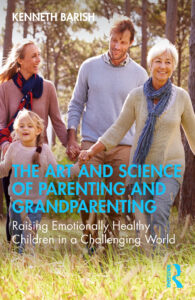
 Dr. Kenneth Barish has worked with children and families for over three decades. He teaches post-graduate classes in adolescent development, psychoanalysis, neuropsychological testing, and child psychotherapy, and he has published several widely read articles on child psychotherapy. River Journal asked Barish about his new book. His responses have been edited for space.
In the book, I offer advice, based on both science and over 40 years of clinical practice, on some of the most important concerns of contemporary parents and grandparents: How we can protect our children’s emotional health, support their love of learning, have better conversations, and nurture children’s empathy and kindness toward others. I also offer practical plans for solving many common problems of daily family life.
I am a Westchester boy, born and raised in Mount Vernon in the 1950s and 60s. I returned to Westchester after college and graduate school to work and raise my family, first in Hartsdale, then in Larchmont/Mamaroneck. We moved back to Westchester from NYC so that our children would have a sense of community, space to play outside, and we would be able to live near where I worked. I have maintained my clinical practice in the same Hartsdale office for the past 46 years.
The Art and Science of Parenting and Grandparenting is my fifth book. The book began as a course I taught, offered by Yale Alumni College in 2022. I worked on the book in its current format for two years.
During the past decade, I have had the opportunity to put aside several mornings a week devoted to writing. I now write every morning and only in the morning, in my home office. Like many writers, I do not write well in the afternoon.

I often explain to colleagues and parents (and to teenagers I work with in therapy) that writing is the most demanding intellectual task, because writing requires the most self-generated cognitive effort. I can listen well and have good conversations at other times of the day or evening, but writing is different. It is all coming from us. Writing requires cognitive processes – working memory and, especially, cognitive flexibility – that, for most people, fade as the day progresses.
Here is some advice for new writers about the challenges of writing.
- This is the most important advice: There will be, inevitably, during your writing (as in any creative endeavor) moments of frustration, discouragement, and self-doubt. Know that these moments will be there; it will help you work through them.
- Write something, a paragraph or a sentence, even a sentence fragment, as often as possible. When you come back to it, you will not be starting over, and it will be much easier to expand your nascent idea. This advice comes from George Bernard Shaw, who, as a young man, decided to fill one journal page every day, no matter how bad he thought it was.
- Do not sit in one place for a long time. Get up, move around, take a walk. When Ernest Hemingway was writing, he would walk back and forth in his Havana apartment, stop to type something, then walk again.
- If you feel stuck, talk it out with someone. You may find that explaining to someone what you are trying to say immediately helps you to find the best way to say it.
- Finally, have trusted friends and family members read early drafts. There are so many decisions, large and small, we have to make in writing a book, even in writing a sentence! We need help from others. We can’t solve every writing problem ourselves.
I have presented talks on parenting and other subjects to professional, civic, and parent groups throughout the county. Recently, I spoke at the Scarsdale Library on Bridging Our Political Divide.
We are long-time members of the Westchester Jewish Center. I am on the faculty of the Westchester Center for the Study of Psychoanalysis and Psychotherapy and the Westchester Behavioral Health campus of Weill Cornell Medicine, where I trained and now teach child and adolescent therapy.
We dine all over Westchester, from the River Towns to the Shore towns. I am also an amateur jazz musician. (I play trumpet.) Some of the best jazz we’ve heard over the years has been at Jazz Forum Arts in Tarrytown and Red Hat on the River in Irvington.
The book was published by Routledge on June 29, 2026, for $25.99 (on Amazon).