




A routine meal out should feel simple. For Cooper Ho, a student at Hackley School in Tarrytown, it never has. Living with tree nut and shellfish allergies, he has learned to navigate menus carefully and ask the right questions. But even with precautions, there have been moments when things went wrong. The most frightening happened two summers ago while traveling in the UK, when he had a severe allergic reaction at a restaurant after being told his dish was safe. Unable to get an ambulance, he had to find a taxi and make his way to the emergency room.
Experiences like that stayed with him. They are life threatening for diners, but they also point to something larger. A safe dining experience matters for everyone involved. That idea led Ho to start Safe Plate Alliance, an organization focused on improving food allergy safety for both restaurants and their customers.
His work quickly turned toward a growing part of how people eat today. Food delivery platforms like DoorDash and Uber Eats have become a regular part of daily life, especially for families. But for people with food allergies, ordering delivery can feel uncertain in a way that dining in does not. In a restaurant, a customer can speak directly with a server, ask questions, and feel more confident that their concerns are heard. With delivery, communication often comes down to a small comment box at the bottom of an order.
Ho wanted to understand how widespread that issue is locally. As part of a research project, he surveyed about 50 restaurants across a dozen towns in Westchester County, looking at how they handle allergy information on both major platforms. The results were consistent across the board. Roughly 80 percent of restaurants had no allergy features enabled at all, leaving customers to rely on general order notes.
That small detail carries weight. The comment box is used for everything from extra napkins to special requests, and there is no clear indication that a life-threatening allergy will be seen or handled properly in the kitchen. For families managing allergies, that uncertainty can turn something as simple as ordering dinner into a stressful decision.
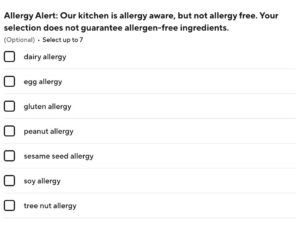
What makes the gap more striking is that the tools already exist. Both DoorDash and Uber Eats offer dedicated allergy intake features that allow customers to clearly indicate allergens in one place, separate from general notes. On Uber Eats, Cooper found that enabling this feature appears to be a simple setting within the restaurant’s system. On DoorDash, options like menu labeling are available, though the setup process for full intake forms is less clear. Restaurants like Terra Rustica, Bareburger, Taco Project, Saigonese, and Playa Bowls had these enabled across both platforms and deserve recognition for it.
In many cases, the issue may not be a lack of care. Ho notes that many local restaurants handle food allergies well for dine-in customers, with knowledgeable staff and trained kitchens. The challenge may simply be awareness. By reaching out to restaurants one by one, he hopes to bridge that gap and make sure these tools are being used.
So far, responses have been limited but encouraging. One restaurant said it would pass his message along internally. Cooper understands that restaurant teams are busy, and his goal is not to call anyone out, but to offer a simple step that can make a difference.
The impact could extend beyond safety. Studies show that many people with food allergies avoid ordering from restaurants altogether because of uncertainty. For local businesses, that represents customers who are quietly opting out.
With Food Allergy Awareness Week approaching from May 10 to 16, Ho is continuing his outreach across Westchester. His goal is to reach as many restaurants as possible and raise awareness among both businesses and diners. If the model works locally, he hopes it can expand to other communities. For him, it comes down to something simple. Everyone deserves to feel safe when they sit down to eat, whether that meal is at a table or delivered to their door.