

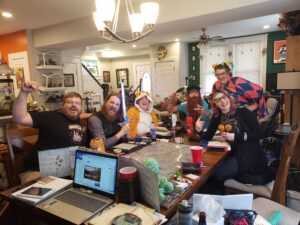
You’re sitting around a table with five other people you now consider your friends. You might begin in a town or a tavern, facing a problem of some sort—a monster, a looming threat, a missing person—though it could be almost anything.
You travel, investigate, make alliances, and uncover clues. You face monsters, traps, puzzles, moral choices, and rival factions. Dice rolls determine success or failure in risky moments.
As the story unfolds, the stakes rise. Four hours pass. You’ve ventured far from where you began and explored worlds unseen before—yet you’re still sitting at the same table. You’ve spent the evening storytelling, improvising, and role-playing within a framework of rules that somehow still makes anything feel possible. Perhaps most surprising of all: no screens were involved.
That is the essence of Dungeons & Dragons—or D&D.
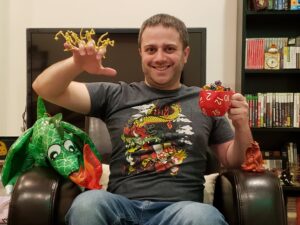
Briarcliff Manor resident Adam Samtur is a Dungeon Master (DM) and the owner of TableTopNow, a Westchester-based organization that brings people together through tabletop role-playing games. His role is to build the world, introduce its challenges, and guide players through the story. He narrates scenes and outcomes using tools like dice, map tiles, character sheets, and figurines to bring the adventure to life. Still, the story belongs to the players—whether they’re playing wizards, barbarians, or warlocks—whose choices shape what happens next.
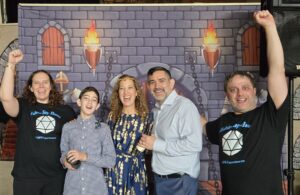
Interest in D&D has surged in recent years, fueled in part by its prominent role in Stranger Things, other mainstream shows like Community, and online fan communities. Samtur has been a DM for around a decade, running games for libraries and game centers throughout Westchester, the Tri-State region, and beyond.
His business, TableTopNow, fills a growing need for people eager to play but lacking a Dungeon Master—the one role every Dungeons & Dragons game requires. Samtur works with a core group of trained DMs who run games for players of all ages and experience levels.
“I’ve probably gotten ten emails in just the last week from people saying, ‘We just watched the Stranger Things finale—how do we play?’” Samtur said. “There’s a huge interest out there, right in our own communities.”
In addition to running games, Samtur trains future Dungeon Masters, helping them join TableTopNow’s network and gain paid experience serving their communities.
“There are plenty of people who want to be players,” he said, “but not nearly enough Dungeon Masters. That gap is really where TableTopNow came from.”
Originally developed in the 1970s as a fantasy role-playing game rooted in tabletop war games, Dungeons & Dragons carried a heavy stigma for much of its early history. During the 1970s and ’80s, its fantasy elements were often taken literally by critics.
“People heard dungeons, dragons, dark magic, warlocks, and thought D&D was anti-Christian satanic worship disguised as a game,” Samtur said.
By the late 1980s, the controversy faded. “It didn’t really come back because of some big reversal—it just sort of fell off the map, and then society moved on,” he said. Today, D&D is widely embraced as a creative, social activity that feels tame compared with modern video games and media.
To play D&D, only three essentials are needed: dice, character sheets, and a DM. Preparing a session often requires as much time as playing it, and the success of the game depends on the DM’s ability to hold everything together.
According to Samtur, the benefits of D&D extend far beyond entertainment. Long-running campaigns help players—especially children—develop social skills and teamwork.
Over the years, Samtur has run D&D programs at more than 20 libraries and community venues, where he says the games consistently draw strong attendance.
“Libraries and community centers love hosting these games because they end up being some of their most popular,” he said. “They boost attendance and get people active and engaged with the space and with one another.”
“I have a library in Greenwich where I’ve been playing with the same group of kids—some of them were nine, and now they’re 13 or 14,” Samtur added.
The game’s cooperative structure encourages communication and empathy, particularly in larger groups where decision-making takes time. Samtur notes that players gravitate toward different aspects of the experience, whether analytical problem-solving or creative role-playing.
That flexibility allows D&D to thrive in many settings. Samtur has run corporate events and private celebrations as well.
“D&D can be a structured team-building exercise, or it can be a fun party,” he said. “One bar mitzvah I was hired for wasn’t even sitting around a table rolling dice—it was running around and playing D&D games.”
Samtur emphasized that D&D is especially valuable as an inclusive activity. Many players are on the autism spectrum or experience social anxiety, and the game provides a structured yet imaginative environment where they can participate comfortably.
“I think of this as an opportunity for local venues—and the community at large—to bring what is now the world’s most popular non-video game into their spaces,” he said.