 The River Journal joins this year’s celebration of the 250th anniversary of the founding of America with a series of articles throughout 2026 highlighting people, places, or things in the River Towns that pay homage to pivotal times in our history.
What comes to mind when you see the phrase “historic landmark”? Do you think of the Empire State Building – one of 1.5 million properties listed on the National Register of Historic Places? What about the Usonia Historic District in Pleasantville – a collection of distinctive homes attributed to architect Frank Lloyd Wright? Or Sleepy Hollow Cemetery where famous financiers, performers, and authors are buried? How do we define “historic landmark” and what is its significance in the story of America?
To appreciate the range of possibilities, let’s meet Clio (www.theclio.com), a free downloadable educational website and mobile application on your phone and at your fingertips offering a digital tour guide to 42,000 historic spots throughout the country. Based on your location – or any destination you type into the search function – you can pinpoint and plan out visits to museums, parks, walking tours, heritage trails, and other curated experiences. Clio gives turn-by-turn directions and maps, descriptive text, photos of the site, and links to relevant books, articles, videos, and other credible sources for further information.
Once you’ve familiarized yourself with options on the app, experiment with searches of random destinations. You may be surprised by what pops up: Sites you may not have considered to be within a definition of “historic landmark.” Examples: neon (Las Vegas, Nev.); lava bed (Tulelake, Cal.); a yard of bricks (Augusta, Maine); a Santa Claus crime scene (Cisco, Texas) a rose testing garden (Portland, Ore.); murals (Philadelphia, Pa.) an aerial tram (Little Cottonwood Canyon, N.C.); an artificial cloud (Tulsa, Okla.); a blue painted whale (Salt Lake City, Utah); and a lunch counter (Greensboro, N.C.).
Clio challenges us to broaden our idea of what constitutes a historically or culturally significant structure, area, or artifact and invites us to consider wider contexts such as archeology, science, and all aspects of popular culture, and reminds us that history is being made all around us.
Working with local history experts, historical societies, and college students pursuing scholarship in the humanities, Clio expands and updates entries on the website and invites you to contribute information about a location you consider to be worthy of preservation, recognition, and memorialization. You submit the information through the Clio website to be vetted, referenced, and then posted. Clio’s YouTube videos provide helpful instructions.
Last month we described the monuments and markers in Patriots Park in Tarrytown as the first installment in a series celebrating our nation’s 250th anniversary. Taking the next step in exploring historical sites in the River Towns, we let Clio lead the way. Using the search parameters of “10-mile radius” and “Tarrytown,” Clio lists 2,638 results pointing out historic districts, churches and synagogues, mansions and the lighthouse, cemeteries and railroad stations, a sculptor’s studio in Greenburgh, and an archeological site in Dobbs Ferry – to name a few.
But two citations in particular expand on the Captors Monument story. Clio’s entry “André’s Spring” reads in part: “On the morning of September 23, 1780, British Major John André stopped at a spring that was located on Hardscrabble Road in what is now Briarcliff Manor to water his horse. He also exchanged greetings with Sergeant Sylvanus Brundage who was sitting on his porch across the road … little did Brundage know that Major André was a British officer returning to British headquarters in Manhattan after meeting with American General Benedict Arnold. A historical marker was placed at the site of the spring by the Daughters of the American Revolution in 1885.”
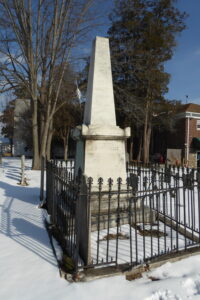
A second citation takes us to Route 9A just past the Elmsford Post Office to the site of the once-active Elmsford Reformed Church and its small adjoining cemetery with burials dating from 1793 to 1913. The largest monument marks the grave of Isaac Van Wart, one of the three militiamen who captured Major André and whose name is inscribed on Captors Monument. Another burial at the cemetery is Solomon Utter who built the gallows on which Major André was hanged.
The worn stone makes deciphering the four inscriptions on the Van Wart monument difficult, but Clio includes the full texts including “Isaac Van Wart was a Faithful Patriot, one in whom the Love of Country was Invincible and this tomb bears testimony that the Record is True.”
David Trowbridge, a research professor in digital and public humanities at the University of Missouri and author of the collegiate textbook A History of the United States, created Clio because “there is something powerful that occurs when our sense of the past connects with our sense of place.”
Your American landmark journey is ready. Just ask Clio.