 For educators pursuing careers in Career and Technical Education (CTE), the U.S. job market presents a clear divide. Some states offer vast numbers of teaching positions, while others compensate educators with significantly higher salaries. Understanding where opportunity and pay intersect is critical for teachers seeking long-term stability, professional growth, and financial security in technical education fields.
The research by the e-learning platform, eLearning Industry, analyzed Bureau of Labor Statistics (BLS) data on Career/Technical Education teacher employment and wages across middle, secondary, and postsecondary levels. The findings highlight where teaching careers in technical fields are most viable, indicating where educators may find both demand and competitive pay.
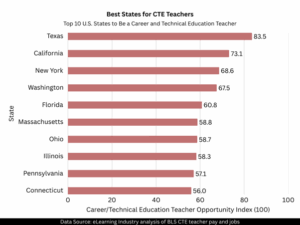
New York ranks third, with an Opportunity Index of 68.6. The Empire State averages 4,170 CTE teacher positions, with wages averaging $84,953. Teacher employment scored 12.3, while wages earned a 56.3 score.
Looking at the study, a spokesperson from eLearning Industry commented:
“This research shines a spotlight on the states where Career/Technical Education teachers can truly thrive. New York ranks third, offering the ideal balance of abundant job opportunities and competitive wages for professionals in this field.
“It’s important to understand what drives these rankings. High Opportunity Index scores reflect more than just salary – they capture the availability of quality positions and the overall demand for skilled CTE educators, highlighting where teachers can build rewarding, long-term careers.”
What Should Career/Technical Education Teachers Consider When Choosing a State?
Experts reviewing the data highlight several key factors CTE teachers should consider when evaluating states:
- Assess both average wages and employment demand to understand overall career opportunities.
- Evaluate the potential for career growth across middle, secondary, and postsecondary levels.
- Consider the cost of living alongside wages to determine true financial benefit.
- Examine state-specific support for CTE programs, including funding, industry partnerships, and professional development.
- Factor in long-term stability, retirement benefits, and local education policy trends.
Top 10 U.S. States to Be a Career and Technical Education Teacher
- Texas – Opportunity Index 83.5
- California – Opportunity Index 73.1
- New York – Opportunity Index 68.6
- Washington – Opportunity Index 67.5
- Florida – Opportunity Index 60.8
- Massachusetts – Opportunity Index 58.8
- Ohio – Opportunity Index 58.7
- Illinois – Opportunity Index 58.3
- Pennsylvania – Opportunity Index 57.1
- Connecticut – Opportunity Index 56.0
Table for Extended Results:
| Top 10 U.S. States to Be a Career and Technical Education Teacher | ||
|
State |
Career/Technical Education Teacher Opportunity Index (100) | Rank |
| Texas | 83.5 | 1 |
| California | 73.1 | 2 |
| New York | 68.6 | 3 |
| Washington | 67.5 | 4 |
| Florida | 60.8 | 5 |
| Massachusetts | 58.8 | 6 |
| Ohio | 58.7 | 7 |
| Illinois | 58.3 | 8 |
| Pennsylvania | 57.1 | 9 |
| Connecticut | 56.0 | 10 |
The study was conducted by eLearning Industry, a trusted platform that provides expert content and tailored marketing solutions to help eLearning platforms, HR software companies, and corporate training providers grow and engage their target audience.
Methodology
The analysis leveraged Bureau of Labor Statistics (BLS) data to compare Career/Technical Education teacher employment and wages across middle school, secondary, and postsecondary levels in all 50 U.S. states for 2025. Each state’s Teacher Employment Score and Teacher Wage Score were calculated based on relative employment levels and average wages, respectively. The Career/Technical Education Teacher Opportunity Index Score (out of 100) synthesizes both metrics to identify states offering the strongest overall opportunities for CTE teachers. States with the highest index scores represent markets where career demand and compensation align most favorably.
Data Sources