


From her home in Irvington, Meredith Beckford-Smart helped lead one of the largest and most ambitious space research simulations ever conducted, proving that world-changing work can begin right here in Westchester.
Last fall, Beckford-Smart served as a Mission Control flight director for MWEZI ONE, part of the World’s Biggest Analog, the largest coordinated analog space mission in history. Analog missions simulate what it’s like to live and work on the moon or mars here on earth, allowing researchers to study human behavior, technology, sustainability, and teamwork under extreme conditions.
What made this mission historic was its global scale. Sixteen analog space habitats across multiple continents operated under one synchronized research framework, bringing together scientists and educators from more than 25 countries. MWEZI ONE, a lunar simulation habitat, also marked the establishment of Africa’s first analog space exploration habitat, expanding who gets to participate in shaping the future of space research.
As Mission Control flight director, Beckford-Smart led mission operations, supported the crew, coordinated schedules and communications, and ensured research protocol was followed. The role required constant collaboration with teams across time zones, cultures and disciplines. “At its core, it was about leadership and systems thinking,” she said. “Keeping people connected, calm and focused while managing a lot of moving parts.”
While the mission spanned the globe, much of the planning and coordination happened right here in Irvington. From her home base, Beckford-Smart worked daily with partners in Austria, Kenya and the Caribbean, showing that global space research does not have to begin at a launchpad. “World-changing work doesn’t always start in a lab or at NASA,” she said. “It can start at a kitchen table, in a classroom, or in a small community with big ideas.”
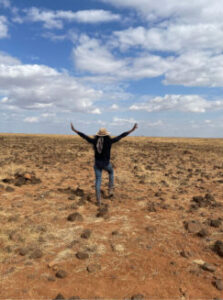
The Africa-based habitat was established in North Horr, Marsabit County Kenya, a remote and arid region chosen for its resemblance to lunar conditions. Located within the ancestral lands of the Gabbra community, a pastoralist and nomadic people, the site reflected a commitment to inclusive, place-based research. Beyond space simulation, the mission explored off-grid energy systems, water access, food planning, sanitation, and sustainable living; challenges that matter both for future space missions and for communities on Earth.
Throughout the mission, teams faced unpredictable conditions, from power limitations to communication challenges, requiring constant adaptation. In many cases, the team learned directly from the Gabbra community’s lived experience of navigating extreme environments. “Those moments reminded us why analog missions are so important,” Beckford-Smart said. “They prepare us not just technically, but humanly.”

An educator for more than two decades, Beckford-Smart is also the author of Ollie’s Big Dream: A Journey to the Stars. For her, the mission was a natural extension of her work making science accessible and inspiring for young people. “Storytelling and simulation help students see themselves as scientists and explorers,” she said.
She hopes her involvement in the mission shows Westchester students that space science is not distant or unattainable. “I want students in our community to feel hopeful about the world that they will inherit and realize that STEM opportunities are within reach,” she said. “Leadership is about service, teamwork and vision.”
Looking toward the future, Beckford-Smart plans to continue connecting the concepts of space research, education and community engagement. For Westchester, her work serves as a reminder that innovation thrives in local communities, and even the path to the moon can begin at home.