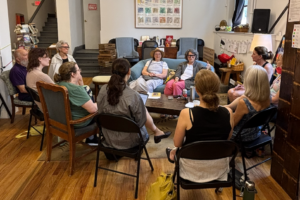



Rehabilitation Through the Arts, the Purchase-based nonprofit whose work was highlighted in the film Sing Sing, has launched its program to prepare women at the Taconic Correctional Facility in Bedford for life after prison.
Reimagining Myself is geared toward providing women with access to the same transformative opportunities that have already made a profound difference for men.
The program (known as RM) is built around women’s voices, grounded in the belief that transformation begins with self-understanding.
When RTA launched the first RM pilot for men in 2020, it confirmed what the organization had long known — that creative expression helps people rediscover who they are and imagine who they can become.
Developed under the leadership of Kate Kenney and supported by Dawn McDonald, RM managers and curriculum co-authors, this 10-week, arts-based, trauma-informed reentry program deepens RTA’s mission to use the arts as a catalyst for rehabilitation, connection and community reentry.
The women’s version of RM began with listening. Kenney and the RTA team interviewed both currently and formerly incarcerated women across the country, asking about their hopes, fears and what they most needed during reentry. Their stories shaped the adapted program almost in its entirety.
Through those conversations, themes emerged: the struggle to reclaim autonomy after years of confinement; the pressure to resume caretaking roles immediately upon release, the weight of unaddressed trauma and shame, and the deep desire for connection, creativity, and joy.
“We thought maybe 12 or 13 of the 20 sessions would overlap with the men’s version,” Kenney explains. “But once we started listening to women, we realized we’d need to rebuild almost everything. In the end, only three sessions carried over. The rest are completely new.”
What resulted was a curriculum centered on women’s emotional realities. Each session uses art — writing, performance, and visual expression — as a tool for reflection and growth. Participants learn to identify emotions, set healthy boundaries, and envision the lives they want to lead after release.
What makes RM different?
Unlike many state-mandated reentry programs focused on job readiness or paperwork, RM explores the social and emotional dimensions of reentry — the foundation for lasting success.
“It’s not just about teaching someone how to get an ID,” said Kenney. “It’s about helping them understand who they are and how to bring their best self into every space they enter. Because real reentry isn’t only about leaving prison—it’s about reentering your own life.”
Participants meet twice a week over 10 weeks in 90-minute sessions led by justice-impacted facilitators — people who have lived through reentry themselves. These facilitators guide, model vulnerability, and co-create the learning experience alongside participants.
Facilitators complete 25 hours of training that includes trauma-informed care, emotional regulation, and self-care. Regular check-ins and mentoring ensure they are supported as they help participants heal and grow.
RTA designed RM to be evaluated both rigorously and humanely. Participants complete anonymous reflections after each session, allowing the team to assess individual growth and curriculum effectiveness. These insights — along with facilitator reports — are analyzed by researchers at the University of Connecticut at New Haven to measure changes in confidence, self-awareness and readiness for reentry.
This ongoing evaluation helps RTA refine the program continuously, ensuring it remains responsive and impactful.
Reimagining the future
More than a series of workshops, Reimagining Myself creates space for healing. Through creativity and dialogue, women reconnect with their sense of agency and practice empathy, communication, and self-acceptance — the foundations of strong communities.
The program is a reminder that behind every prison wall are human beings — mothers, daughters, sisters — each with complex emotions, regrets and hopes. Reimagining Myself honors that humanity, offering a path not just toward reentry but toward personal renewal.
“There are real human beings with complex emotions and experiences inside,” shares Kenney. “Any one of us could be there, under different circumstances. The arts remind us of that shared humanity.”
The program’s launch represents a cultural shift in how reentry is defined. True rehabilitation goes beyond practical skills; it begins with self-awareness, reflection and creative exploration.
With this expansion, RTA continues to demonstrate that the arts are a powerful force for change — unlocking resilience, connection, and possibility both inside and beyond the walls.
As the first cohort of women begins the journey, they are not simply preparing to reenter society — they are reimagining themselves and their futures.
Reimagining Myself (Women’s) which also launched in October at the Albion Correctional Facility in Orleans County — marks RTA’s expansion to 11 sites across New York State, including Sing Sing Correctional Facility in Ossining.
Visit rta-arts.org to learn more about and support RTA’s reentry and arts-based rehabilitation programs.