

Through the generous support of Regeneron, four times a year River Journal publishes the on-site report of a high school science student from the River Towns who is paired with a Regeneron scientist to experience what it is like to put STEM education to work in the real world.

Mount Sinai Hospital.
Through the help of River Journal and the Ossining High School Science Research program, I had the opportunity to visit Regeneron in Sleepy Hollow. Walking through the halls of Regeneron was a surreal experience. I couldn’t believe the impressive work that was happening before me. As so many scientists with bright minds walked past me, I felt their energy. Seeing how much scientific thought and effort go into biomedical research really inspired me to start a project of my own.
I had the pleasure of speaking one-on-one with Regeneron scientist Pratyush Rai, PhD, PMP, the Senior Manager in the Digital Biomarkers lab, a state-of-the-art lab that focuses on use of advanced digital tools to track patients’ health and provide valuable data during clinical trials at Regeneron. The focus of his lab is to study digital biomarkers, which are physiological or behavioral data that can be collected from patients using wearable digital devices that may be used to help predict disease outcomes and monitor health status, for example. Dr. Rai was inspired to be a scientist, given that he was surrounded by science in his childhood; his father was an engineer, and his mother was a bioengineer. He obtained his undergraduate degree in biotechnology, and he earned his PhD in biomedical engineering at the University of Arkansas at Fayetteville.
Dr. Rai explained that his research group is currently working on several projects, which include digital measures for monitoring patients for their heart rate and respiration rate while tracing their daily physical activity. This can be potentially solved by using smart chest patches to monitor heart rate and posture throughout the day.

The lab uses this camera based system and retroreflective markers to track the body movements of a person while performing daily activities or posture changes such as sit to stand, lying down in bed, reclining in a chair, doing house chores and preparing a meal. The cameras are positioned throughout the lab space, and retroreflective markers are placed on specific parts of the persons’ body, such as the wrists and ankles. Using the retroreflective markers, software can generate a 3D image of the person and track their movements. This is used as the ground truth to compare activities of daily living monitoring for accuracy evaluation of the chest patch.
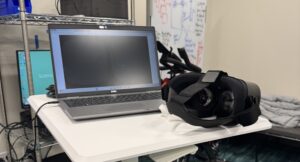
One of lab’s other projects involve an innovative testing for retinal lesions using VR- headsets. His lab uses VR headsets to test participants’ field of vision. Participants are asked to focus on a target stimulus on the screen in a specific region. The participant cannot see the stimuli if there is loss of retina cells in the specific region. This solution is being used to provide valuable data in clinical trials at Regeneron to get improved outcomes.
The work being done in the lab is very impressive and is being implemented in clinical trials. In order to keep his research projects running smoothly, Dr. Rai works with a variety of professionals, including biomedical engineers, medical doctors, clinical trial experts, data management experts, statistician, and business development people. The diverse backgrounds and specialties of lab’s research group foster a vibrant scientific atmosphere and a wealth of ideas and scientific progress.
After meeting with and talking to Dr. Rai, I left Regeneron ready to start working on my own research project to continue my love of scientific exploration.